
Causes of groin injury
Short answer
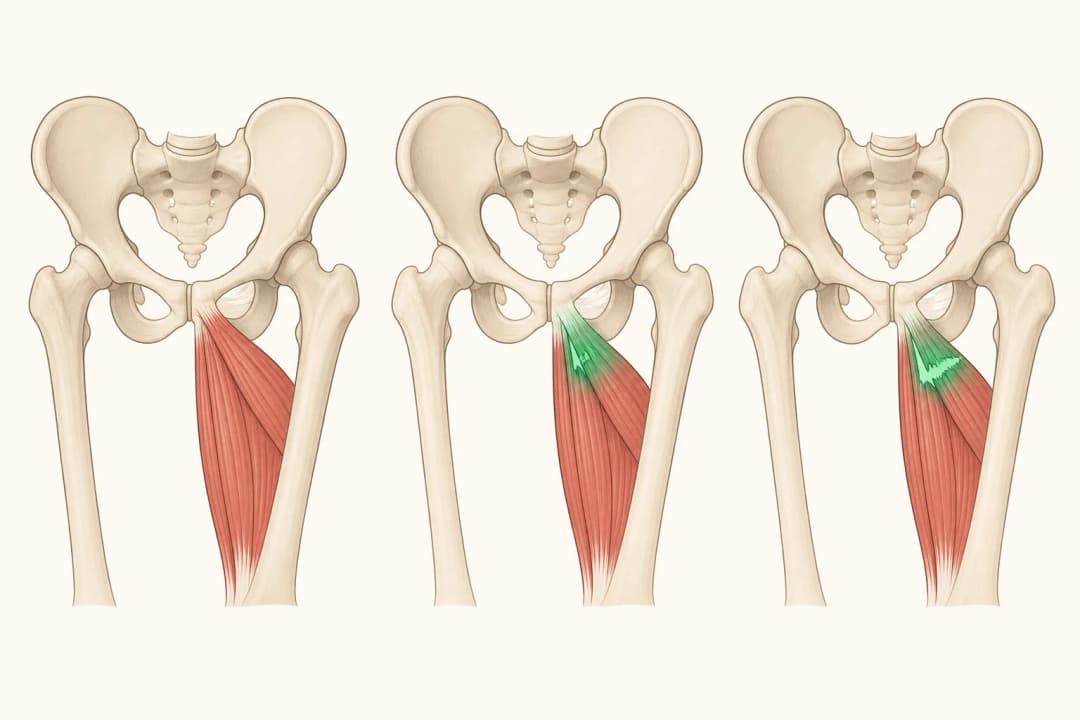
A groin injury often occurs when the inner-thigh muscles are forcefully stretched or loaded beyond their current capacity.
This answers one question. It is not a diagnosis and does not replace an assessment by a licensed doctor.
At a glance
- Common mechanism
- Fast direction changes or kicking can overload the adductors.
- Pain source
- Muscles, tendons, hip, abdominal wall, or pelvic structures may contribute.
- Return to activity
- Restore strength before progressing to high-speed sport tasks.
How a groin injury happens
Sudden acceleration, cutting, kicking, slipping, or changing direction can strain an adductor muscle or its tendon. Repeated high-load activity without enough recovery may instead produce a gradual ache. Groin pain can also originate from the hip joint, abdominal wall, pubic region, or other nearby structures.
Patterns that help locate the problem
An adductor strain commonly hurts where the inner thigh meets the pelvis and is aggravated by squeezing the legs together, running, or kicking. Previous groin problems, a sudden jump in training load, fatigue, and inadequate strength for the activity can make tissue overload easier.
Pain with coughing or a visible bulge may suggest an abdominal-wall or hernia problem. Deep catching or restricted hip movement can point toward the hip joint. Testicular, urinary, pelvic, or abdominal symptoms require a wider medical assessment rather than being assumed to come from muscle.
Early care and safe rehabilitation
Stop the movement that caused sharp pain and protect the area from forceful stretching. Relative rest, a wrapped cold pack, and comfortable walking may help early symptoms. Avoid repeatedly testing a painful sprint or kick, because this can keep the tissue irritated.
As pain allows, rehabilitation usually progresses from comfortable range of motion to adductor and trunk strengthening, then running, direction changes, and sport-specific tasks. A return-to-sport programme should test the demands of the activity rather than relying only on how the groin feels at rest.
Red flags and reasons for review
Get urgent help for sudden severe testicular pain or swelling, a painful groin bulge that will not reduce, severe abdominal pain, vomiting, faintness, or blood in urine. After trauma, inability to bear weight, visible deformity, or rapidly expanding bruising also needs prompt assessment.
Arrange a clinical review if pain is not improving, repeatedly returns with activity, wakes you at night, or is accompanied by fever, unexplained illness, numbness, or weakness. Identifying the involved structure prevents a hip, hernia, or pelvic problem from being managed as a simple strain.
Points to discuss with your clinician
Ask which structure appears injured, whether the hip or abdominal wall needs examination, and what activities are safe now. For sport, clarify the strength and movement markers needed before full training, plus how workload can be increased without provoking another setback.
Find care
General Clinics & Polyclinics in Abu Dhabi
That answer is general. If you want it applied to your own case, these are licensed general clinics & polyclinics listed in Abu Dhabi.
27 Ar Ruwwad St - Shakhbout City - MSH4 - Abu Dhabi - United Arab Emirates
Accepts: Daman, Thiqa, Cigna, MetLife +20 more
Al Ruwais, Al Dhafrah
Accepts: Daman, Thiqa, AXA, Cigna +16 more
Al Bahyah - Al Bahyah Old - Abu Dhabi - United Arab Emirates
Accepts: Daman, Thiqa, Cigna, Allianz Care +18 more
Abu Dhabi
Accepts: Daman, Thiqa, AXA, Cigna +27 more
Ordered by verification status and how complete each clinic's public record is, then alphabetically. This is a directory listing, not a ranking — Zavis does not rate or recommend providers.
A factual listing drawn from the DHA, DOH and MOHAP licence registers. It is not a referral, an endorsement, or advice that any of these providers is right for you.
Questions people ask
Is every groin injury a pulled muscle?
No. The hip joint, tendons, abdominal wall, pubic region, and genitourinary structures can produce pain in the same area.
Should I stretch a new groin strain?
Avoid strong stretching that reproduces sharp pain. Comfortable movement can be introduced first, followed by progressive strengthening and later sport-specific loading.
When can I return to sport?
Return when daily movement, strength work, running, direction changes, and relevant sport skills can be completed with an acceptable response during and after activity.
Related
Related reading
Keep reading
Medical disclaimer. This page is general health information, not medical advice, and it cannot diagnose you. Always consult a licensed healthcare provider about your own symptoms and treatment. In an emergency in the UAE, call 998 for an ambulance.