
Broken Femur at the Hip Joint: What to Know
Short answer
A broken femur at the hip joint is a hip fracture that needs prompt medical assessment and protected movement.
This answers one question. It is not a diagnosis and does not replace an assessment by a licensed doctor.
At a glance
- Anatomy
- The break affects the upper femur near the ball-and-socket hip joint.
- Immediate action
- Keep weight off the injured leg and arrange prompt medical assessment.
- Assessment
- The fracture pattern is determined with examination and imaging.
The short answer
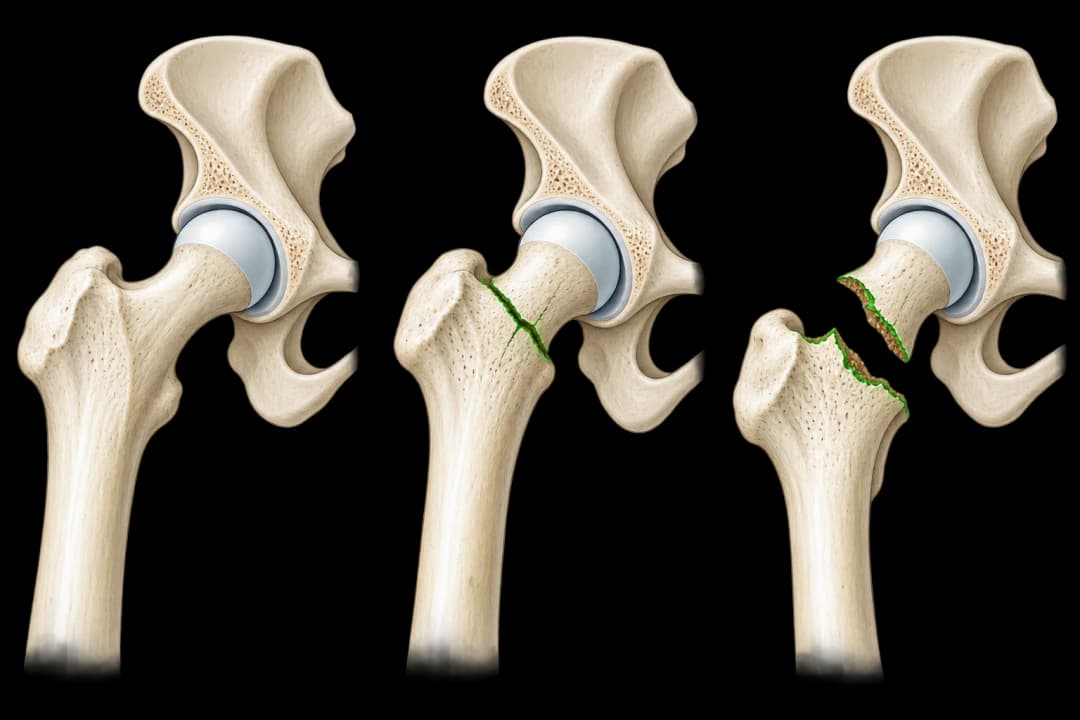
The break is usually in the upper femur, close to where its rounded head meets the pelvis. Pain in the groin or outer hip, inability to stand, and a leg that appears shortened or turned outward can occur. Some impacted fractures still allow limited walking, so being able to take a few steps does not exclude an injury.
Where the break occurs and why location matters
Doctors identify whether the fracture crosses the femoral neck, lies between the bony prominences below it, or extends farther down the upper femur. The pattern and displacement affect blood flow to the femoral head, mechanical stability, and the treatment choice. Examination and hip imaging establish the diagnosis; further imaging may be needed when symptoms remain concerning despite an unclear initial image.
Treatment is tailored to the fracture pattern, bone quality, general health, and the person's previous mobility. Many displaced fractures require an operation to fix the bone or replace part of the joint. Selected stable injuries may be managed differently under close orthopaedic supervision. Rehabilitation then focuses on safe transfers, walking support, strength, and reducing another fall.
What to do after a suspected break
Keep the person still and arrange emergency assessment. Do not ask them to walk, straighten the leg, or test the hip. Support the position they find most comfortable without tightly binding the limb. Avoid food and drink until the clinical team advises otherwise because a procedure or anaesthetic may be considered. Tell responders about the fall or impact, medicines, allergies, blood thinners, and any head injury or loss of consciousness.
After assessment, follow the team's instructions on weight-bearing and walking aids. Pain control, prevention of immobility-related problems, and early guided movement are parts of care. Bone-health evaluation and a review of vision, footwear, medicines, and home hazards may help address factors that contributed to the injury.
When urgent help is needed
Call emergency services after a fall or impact when there is severe hip or groin pain, inability to stand, obvious deformity, an open wound, heavy bleeding, new numbness, or a foot that becomes pale, blue, or cold. Confusion, fainting, chest pain, breathing difficulty, or a possible head or neck injury also require emergency attention.
Seek prompt assessment for persistent hip pain or a new limp after trauma even if the person can still bear some weight. During recovery, urgent review is warranted for worsening wound redness or drainage, fever, sudden breathlessness, chest pain, or new painful swelling in a calf.
Questions for the orthopaedic team
Ask exactly where the fracture lies, whether it is displaced, and how those findings shape the recommended treatment. Clarify when weight can be placed through the leg, which walking aid is appropriate, how pain medicines should be taken, and what changes should trigger a return to hospital. It is also useful to ask about rehabilitation goals and whether bone-strength assessment is appropriate.
Find care
General Clinics & Polyclinics in Abu Dhabi
That answer is general. If you want it applied to your own case, these are licensed general clinics & polyclinics listed in Abu Dhabi.
27 Ar Ruwwad St - Shakhbout City - MSH4 - Abu Dhabi - United Arab Emirates
Accepts: Daman, Thiqa, Cigna, MetLife +20 more
Al Ruwais, Al Dhafrah
Accepts: Daman, Thiqa, AXA, Cigna +16 more
Al Bahyah - Al Bahyah Old - Abu Dhabi - United Arab Emirates
Accepts: Daman, Thiqa, Cigna, Allianz Care +18 more
Abu Dhabi
Accepts: Daman, Thiqa, AXA, Cigna +27 more
Ordered by verification status and how complete each clinic's public record is, then alphabetically. This is a directory listing, not a ranking — Zavis does not rate or recommend providers.
A factual listing drawn from the DHA, DOH and MOHAP licence registers. It is not a referral, an endorsement, or advice that any of these providers is right for you.
Questions people ask
Can someone walk with a broken femur near the hip?
Sometimes an impacted or less displaced fracture permits limited walking, but walking can worsen pain or displacement. Persistent hip or groin pain after trauma needs prompt assessment even when some weight-bearing is possible.
Does every hip fracture need surgery?
No single treatment fits every fracture. The orthopaedic team considers its location and stability alongside the person's health and mobility; many displaced fractures are treated surgically, while selected stable injuries may follow another plan.
What does rehabilitation involve?
Rehabilitation may include transfers, walking with the prescribed aid, exercises for movement and strength, and practical planning for a safe return home. The team sets weight-bearing limits for the specific repair or fracture.
Related
Related reading
Keep reading
Medical disclaimer. This page is general health information, not medical advice, and it cannot diagnose you. Always consult a licensed healthcare provider about your own symptoms and treatment. In an emergency in the UAE, call 998 for an ambulance.