
What should you know about BRAF-mutated melanoma?
Short answer
BRAF-mutated melanoma contains a gene change that can guide targeted treatment decisions and follow-up planning.
This answers one question. It is not a diagnosis and does not replace an assessment by a licensed doctor.
At a glance
- Test
- BRAF testing is performed on melanoma tissue.
- Meaning
- The result helps identify whether pathway-targeted treatment may be relevant.
- Planning
- Stage and overall health remain central to treatment decisions.
What the result means
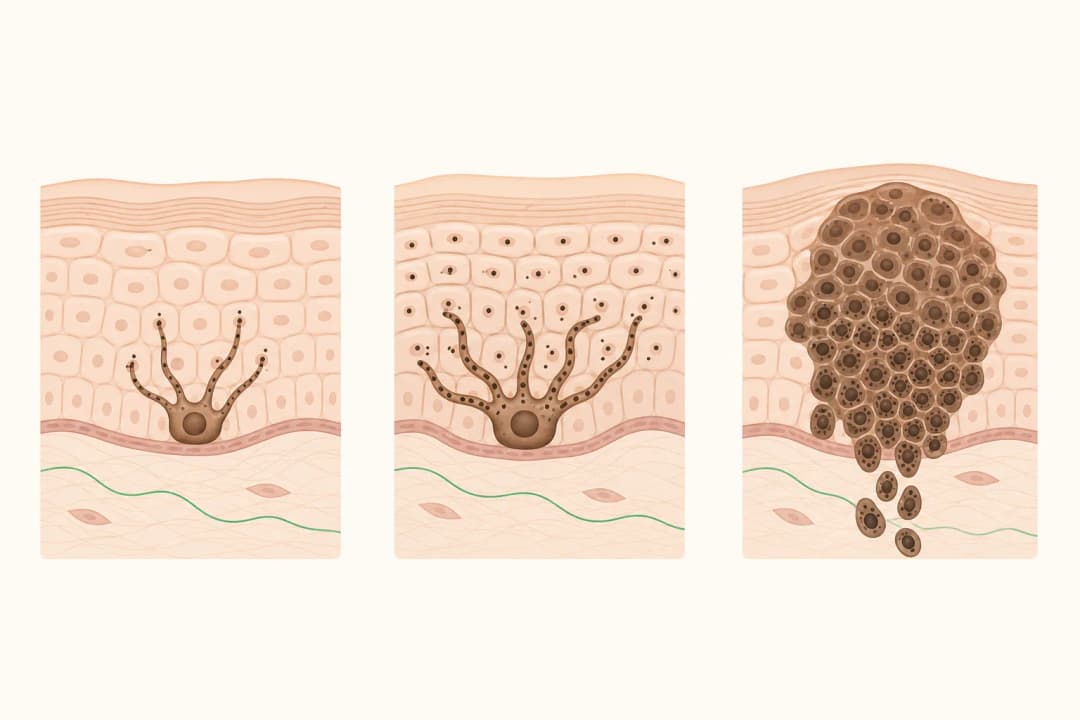
BRAF is a gene involved in signals that tell cells when to grow. In some melanomas, a change in this gene keeps growth signals switched on. A laboratory test on melanoma tissue can identify whether the tumour carries a BRAF change. The result is one part of the picture; the tumour's thickness, ulceration, lymph-node findings, spread, and your general health also shape the outlook and plan.
A BRAF result does not by itself describe how far melanoma has spread. Imaging, examination, and sometimes a sentinel lymph node biopsy help clinicians assess stage. Melanoma can occur on skin or other sites, so the location of the original tumour and any new symptoms matter.
What to do next
Ask which test was used, whether the report says a specific BRAF variant, and how the finding changes your options. Early melanoma may be managed with surgical excision, while more advanced disease may need treatment that reaches melanoma cells throughout the body. Targeted medicines aimed at the BRAF pathway may be considered in suitable situations; immunotherapy is another systemic approach. Treatment selection depends on stage, previous treatment, other illnesses, medicines, and the specialist team's assessment.
Keep pathology and scan reports together, attend planned appointments, and protect treated skin from strong sun while it heals. A follow-up plan can include skin checks, lymph-node assessment, symptom review, and selected scans.
When to seek care promptly
Contact your oncology or dermatology team promptly for a new or changing mole, a firm lump near a treated area, a wound that does not heal, or a new swollen lymph node. Seek urgent medical help for severe breathlessness, new weakness, a seizure, confusion, or a sudden severe headache; these symptoms need assessment and are not proof of spread. If you begin systemic treatment, report severe rash, persistent diarrhoea, yellowing of the eyes, chest pain, or marked shortness of breath without waiting for the next visit.
Questions for your doctor
Which BRAF change was found, and was the result confirmed? What is my melanoma stage and what further tests do I need? Is surgery enough, or should we discuss systemic treatment? How will you monitor treatment effects and new symptoms? What should I do if I miss a dose or develop a rash?
Find care
General Clinics & Polyclinics in Abu Dhabi
That answer is general. If you want it applied to your own case, these are licensed general clinics & polyclinics listed in Abu Dhabi.
27 Ar Ruwwad St - Shakhbout City - MSH4 - Abu Dhabi - United Arab Emirates
Accepts: Daman, Thiqa, Cigna, MetLife +20 more
Al Ruwais, Al Dhafrah
Accepts: Daman, Thiqa, AXA, Cigna +16 more
Al Bahyah - Al Bahyah Old - Abu Dhabi - United Arab Emirates
Accepts: Daman, Thiqa, Cigna, Allianz Care +18 more
Abu Dhabi
Accepts: Daman, Thiqa, AXA, Cigna +27 more
Ordered by verification status and how complete each clinic's public record is, then alphabetically. This is a directory listing, not a ranking — Zavis does not rate or recommend providers.
A factual listing drawn from the DHA, DOH and MOHAP licence registers. It is not a referral, an endorsement, or advice that any of these providers is right for you.
Questions people ask
Does a BRAF mutation prove that melanoma has spread?
No. BRAF describes a tumour gene change, while examination, imaging, and pathology findings assess spread and stage.
Can BRAF-mutated melanoma be treated?
Yes. Depending on stage and individual factors, care may include surgery, pathway-targeted medicines, immunotherapy, or combinations decided by a specialist.
Related
Related reading
Keep reading
Medical disclaimer. This page is general health information, not medical advice, and it cannot diagnose you. Always consult a licensed healthcare provider about your own symptoms and treatment. In an emergency in the UAE, call 998 for an ambulance.