
Blue light cystoscopy with Cysview: what patients should know
Short answer
Blue light cystoscopy with Cysview combines a bladder imaging medicine with specialised light to help the urologist see suspicious areas.
This answers one question. It is not a diagnosis and does not replace an assessment by a licensed doctor.
At a glance
- Imaging medicine
- Cysview, also known as hexaminolevulinate
- How it is given
- Placed into the bladder through a urinary catheter before examination
- Key limitation
- Fluorescence supports inspection but does not replace white light or tissue diagnosis
The short answer
Cysview is the brand name for hexaminolevulinate, an optical imaging agent placed directly into the bladder. It is used as an addition to white-light cystoscopy when clinicians are evaluating certain known or suspected bladder lesions or conducting surveillance.
What happens during the examination
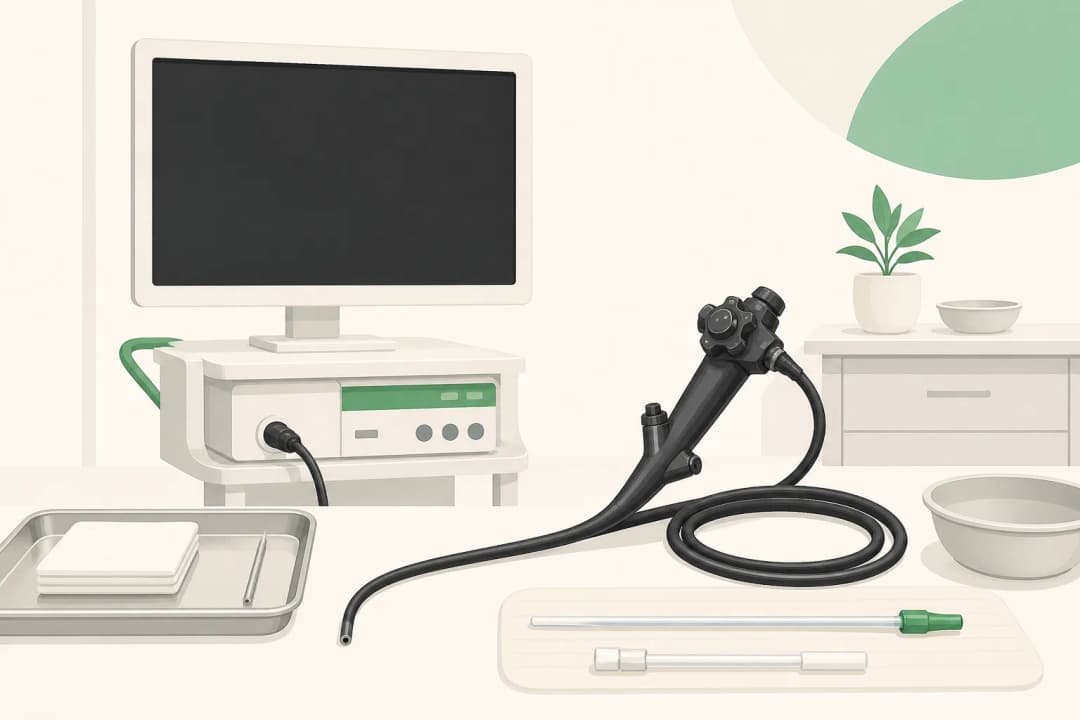
A catheter is used to put the prepared Cysview solution into an emptied bladder before cystoscopy. At the examination, the urologist first inspects the entire bladder under white light and then repeats the view under blue light. Tissue that has taken up the agent may appear fluorescent and can draw attention to an area for closer assessment.
The technique assists detection but cannot identify every malignant lesion or determine a diagnosis on colour alone. Irritation, scars, inflammation, a recent biopsy, or recent bladder treatment can produce misleading fluorescence. The clinician uses the complete examination and, when appropriate, biopsy findings to decide what an area represents.
What to do before and after
Give the team a complete medicine and allergy list, and mention porphyria, pregnancy, visible heavy blood in the urine, infection symptoms, recent bladder biopsy, or intravesical treatment. These details may alter whether or when Cysview is suitable. Use only the fasting and medication instructions provided for your planned anaesthesia.
Plan transport if sedation or general anaesthesia is expected. Once home, follow the written recovery advice and monitor urine colour, discomfort, temperature, and urinary flow. Keep the results appointment even if recovery is uncomplicated, because procedural comfort does not indicate what the examination found.
Symptoms that need attention
Call the treating service urgently for fever or chills, escalating bladder or back pain, heavy bleeding, repeated clots, persistent troublesome burning, or urine that becomes cloudy or foul-smelling. Inability to pass urine with a painful or swollen lower abdomen needs emergency assessment.
Rarely, a medicine reaction can cause hives, swelling of the face or throat, breathing difficulty, dizziness, or collapse. Treat these as emergency symptoms and state that Cysview was placed in your bladder.
Questions for your specialist
Ask what question the examination is intended to answer, whether suspicious areas will be biopsied or removed during the same visit, how prior bladder treatment could affect fluorescence, and when pathology results will be available. Request a clear after-hours contact route before leaving.
Questions people ask
Is Cysview a dye injected into a vein?
No. The prepared solution is placed inside the bladder through a catheter and then drained before the cystoscopic examination.
Why are both white and blue light used?
They provide complementary views. The urologist completes the white-light inspection and uses blue light to help highlight areas that deserve closer assessment.
Can recent bladder treatment affect the view?
Yes. Inflammation or tissue changes after a biopsy or bladder treatment can fluoresce, so the urologist interprets the image alongside your treatment history and any biopsy.
Related
Related reading
Keep reading
Cancer care in the UAE
Hospitals & Medical Centers in Abu Dhabi
Most UAE cancer care is delivered inside hospital services rather than by standalone oncology clinics, so these are licensed hospitals & medical centers listed in Abu Dhabi. Confirm the specific cancer service exists before you travel, and know that asking for a second opinion is routine.
Ahalia Hospital Musaffah Building - Musaffah - Musaffah Industrial - Abu Dhabi - United Arab Emirates
Accepts: Daman, Thiqa, AXA, Cigna +26 more
Al Ruwais Industrial City - Abu Dhabi - United Arab Emirates
Accepts: Daman, Thiqa, AXA, Cigna +30 more
Abu Dhabi, Abu Dhabi
Accepts: Daman, Thiqa, AXA, Cigna +30 more
Second opinions are routine in cancer care and asking for one does not affect your treatment. How to arrange a second opinion in the UAE.
Ordered by verification status and how complete each clinic's public record is, then alphabetically. This is a directory listing, not a ranking — Zavis does not rate or recommend providers.
A factual listing drawn from the DHA, DOH and MOHAP licence registers. It is not a referral, an endorsement, or advice that any of these providers is right for you.
Medical disclaimer. This page is general health information, not medical advice, and it cannot diagnose you. Always consult a licensed healthcare provider about your own symptoms and treatment. In an emergency in the UAE, call 998 for an ambulance.