
Basal cell, squamous cell and melanoma compared
Short answer
Basal cell carcinoma, squamous cell carcinoma and melanoma are three distinct skin cancers with different cells of origin, behaviour and treatment pathways.
This answers one question. It is not a diagnosis and does not replace an assessment by a licensed doctor.
At a glance
- Shared feature
- All three can arise in skin and may be treated surgically
- Essential distinction
- Each begins in a different cellular pathway and has its own assessment
- Diagnostic tool
- Biopsy and pathology establish the specific tumour type
Three separate cancers
A clinician may discuss them together because all can occur on skin and may need surgery. They should not be grouped into one diagnosis. Microscopic examination identifies which cells are involved and provides features needed for an individual care plan.
How the types differ
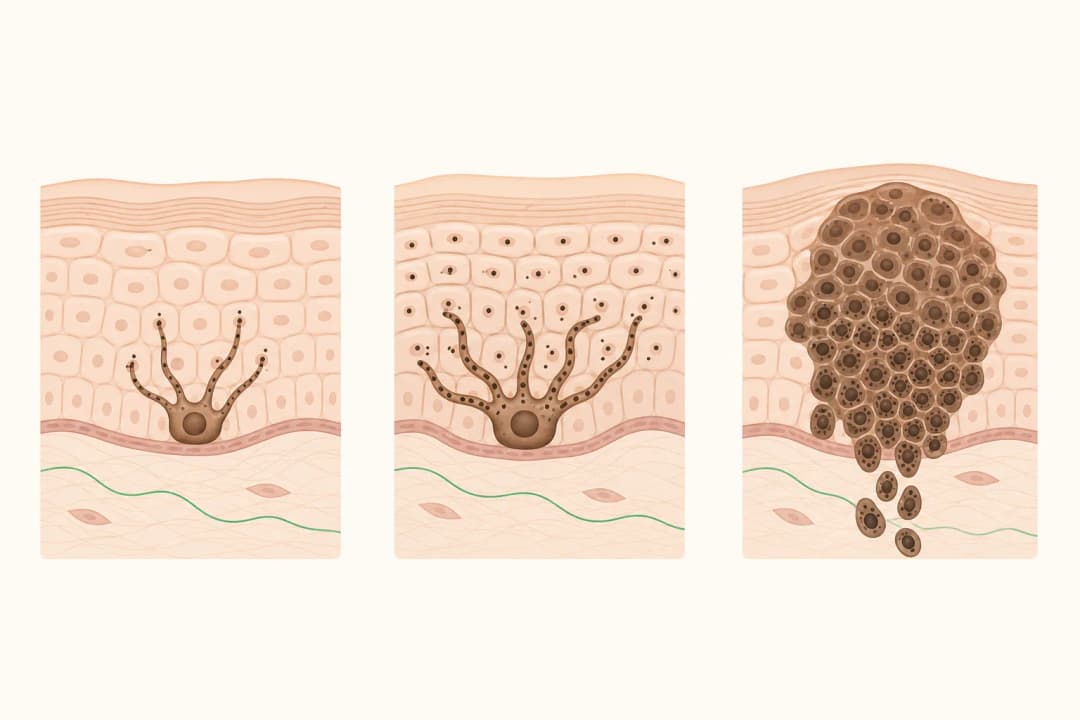
Basal cell carcinoma and squamous cell carcinoma arise from keratinocyte-related cells in the epidermis. Basal cell carcinoma often behaves mainly as a locally destructive tumour. Squamous cell carcinoma is assessed for features that may increase concern about spread. Melanoma begins in melanocytes and follows a separate staging system.
Visual clues overlap. A skin cancer may be pink, brown, black, scaly, shiny, ulcerated or relatively subtle. A biopsy is therefore more dependable than assigning a type from colour or body location.
From biopsy to a care plan
Start with the pathology name rather than a general label such as “skin cancer.” Ask whether the sample removed the whole lesion or only part of it and which report findings affect the next step. Surgical excision may be suitable for any of the three, but the margin and staging approach are diagnosis-specific.
Keep follow-up appointments and learn how to examine hard-to-see areas with a mirror or help from another person. Sun protection reduces further ultraviolet exposure. It cannot determine whether an existing lesion is harmless, so suspicious changes still need assessment.
Signs for timely review
Arrange an examination for a lesion that grows, changes colour or shape, repeatedly crusts or bleeds, remains sore, or fails to heal. Melanoma may present with change in a mole or a new pigmented or non-pigmented lesion. Basal cell and squamous cell carcinomas may present with persistent sores, bumps or scaly plaques.
Request prompt review for rapid enlargement, uncontrolled bleeding, increasing pain, numbness, weakness or a new nearby lump. These signs do not name the cancer type; they indicate that delay could complicate assessment or treatment.
Questions that clarify your care
Ask what diagnosis the biopsy confirms, which pathology features matter, and whether treatment is intended for local removal or also requires staging. If additional surgery is proposed, clarify the margin goal, repair options, recovery limits and how surveillance will be organised.
Find care
General Clinics & Polyclinics in Abu Dhabi
That answer is general. If you want it applied to your own case, these are licensed general clinics & polyclinics listed in Abu Dhabi.
27 Ar Ruwwad St - Shakhbout City - MSH4 - Abu Dhabi - United Arab Emirates
Accepts: Daman, Thiqa, Cigna, MetLife +20 more
Al Ruwais, Al Dhafrah
Accepts: Daman, Thiqa, AXA, Cigna +16 more
Al Bahyah - Al Bahyah Old - Abu Dhabi - United Arab Emirates
Accepts: Daman, Thiqa, Cigna, Allianz Care +18 more
Abu Dhabi
Accepts: Daman, Thiqa, AXA, Cigna +27 more
Ordered by verification status and how complete each clinic's public record is, then alphabetically. This is a directory listing, not a ranking — Zavis does not rate or recommend providers.
A factual listing drawn from the DHA, DOH and MOHAP licence registers. It is not a referral, an endorsement, or advice that any of these providers is right for you.
Questions people ask
Can a lesion contain more than one cancer type?
Unusual mixed or collision tumours can occur, but this requires a pathologist's diagnosis; a combined phrase should not be assumed to describe one.
Are all dark skin cancers melanoma?
No. Benign lesions and some non-melanoma skin cancers can be dark, while some melanomas contain little pigment. A changing lesion needs professional assessment.
Why does the exact type alter surgery?
The tumour type and pathology features influence the margin, whether margin control is useful, and whether lymph-node assessment or other staging is discussed.
Related
Related reading
Keep reading
Medical disclaimer. This page is general health information, not medical advice, and it cannot diagnose you. Always consult a licensed healthcare provider about your own symptoms and treatment. In an emergency in the UAE, call 998 for an ambulance.