
Understanding the phrase basal cell melanoma treatment
Short answer
There is no single diagnosis called basal cell melanoma; basal cell carcinoma and melanoma are distinct cancers with different treatment pathways.
This answers one question. It is not a diagnosis and does not replace an assessment by a licensed doctor.
At a glance
- Terminology
- Basal cell carcinoma and melanoma are separate diagnoses
- Starting point
- The pathology report guides the correct pathway
- Melanoma care
- May involve surgery, staging and systemic therapy
Clarifying the term
Check the exact wording on the pathology report before interpreting advice. A dermatologist or cancer specialist can confirm whether the report identifies melanoma, basal cell carcinoma, or another lesion and explain what its features mean.
Why the distinction changes treatment
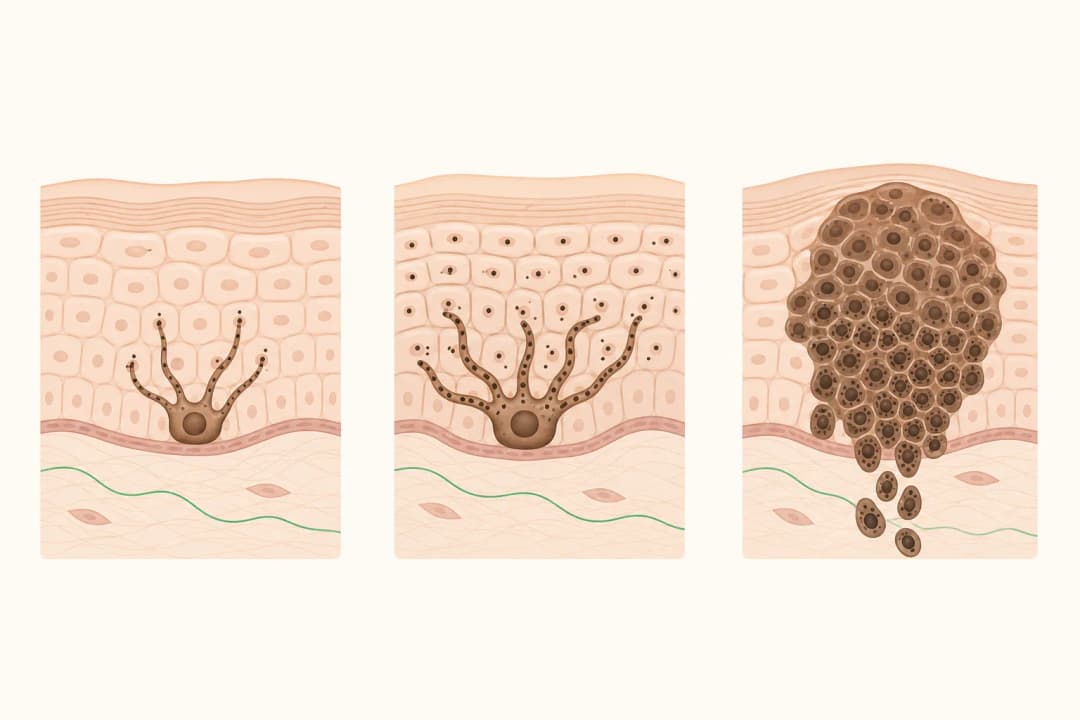
Melanoma begins in pigment-producing melanocytes. Management commonly starts with surgical removal using a margin chosen from the pathology findings. Depending on tumour thickness and other features, the team may discuss sentinel lymph node biopsy to check whether melanoma cells have reached a nearby lymph node.
For melanoma that has spread or cannot be removed fully, systemic treatment such as immunotherapy may enter the plan. Basal cell carcinoma arises from a different skin cell population and is commonly managed with local treatment. A therapy suitable for one diagnosis should not be assumed suitable for the other.
Confirm the report and plan
Obtain a copy of the biopsy report and arrange a review with the clinician managing the lesion. Ask them to point out the diagnosis, measured thickness if melanoma is present, ulceration status, margin findings and whether further staging is relevant.
Avoid delaying a booked procedure while trying to resolve the terminology online. If different clinicians have used different names, request pathology review and a unified written treatment plan.
When prompt review is needed
Arrange prompt evaluation for a pigmented lesion that is changing in shape, colour or size, or one that develops bleeding, ulceration or a new raised area. If melanoma has already been diagnosed, report a new lump near the scar, unexplained neurological symptoms, or a marked decline in general health to the treating team without waiting for routine follow-up.
Questions that clarify the pathway
Ask which cancer the pathology confirms, whether surgery has clear margins, whether lymph-node assessment is appropriate, what further staging could change, and who will coordinate skin surveillance after treatment.
Find care
General Clinics & Polyclinics in Abu Dhabi
That answer is general. If you want it applied to your own case, these are licensed general clinics & polyclinics listed in Abu Dhabi.
27 Ar Ruwwad St - Shakhbout City - MSH4 - Abu Dhabi - United Arab Emirates
Accepts: Daman, Thiqa, Cigna, MetLife +20 more
Al Ruwais, Al Dhafrah
Accepts: Daman, Thiqa, AXA, Cigna +16 more
Al Bahyah - Al Bahyah Old - Abu Dhabi - United Arab Emirates
Accepts: Daman, Thiqa, Cigna, Allianz Care +18 more
Abu Dhabi
Accepts: Daman, Thiqa, AXA, Cigna +27 more
Ordered by verification status and how complete each clinic's public record is, then alphabetically. This is a directory listing, not a ranking — Zavis does not rate or recommend providers.
A factual listing drawn from the DHA, DOH and MOHAP licence registers. It is not a referral, an endorsement, or advice that any of these providers is right for you.
Questions people ask
Can basal cell carcinoma turn into melanoma?
No. They arise from different types of skin cell. A person can develop either condition, so every suspicious lesion should be assessed on its own findings.
Does every melanoma require immunotherapy?
No. Treatment is based on the melanoma's stage, pathology and whether surgery can remove it. Immunotherapy is considered in selected settings rather than automatically.
Related
Related reading
Keep reading
Medical disclaimer. This page is general health information, not medical advice, and it cannot diagnose you. Always consult a licensed healthcare provider about your own symptoms and treatment. In an emergency in the UAE, call 998 for an ambulance.