
What should you know about asymmetrical melanoma?
Short answer
Melanoma may present as an asymmetrical spot whose halves differ in shape, colour or structure, but asymmetry alone cannot confirm or exclude skin cancer.
This answers one question. It is not a diagnosis and does not replace an assessment by a licensed doctor.
At a glance
- Meaning of asymmetry
- The two halves differ in outline, colour or internal pattern.
- Diagnosis
- Appearance guides assessment, while suspicious tissue is examined to establish the diagnosis.
- Action
- A new, changing or unusual lesion should be assessed promptly.
Direct answer
Some harmless moles are uneven, and some melanomas are subtle. A lesion that is new, changing or unlike your other marks deserves professional examination, particularly when it also has an irregular border, varied colours, bleeding, crusting or persistent itching.
What asymmetry means in a skin lesion
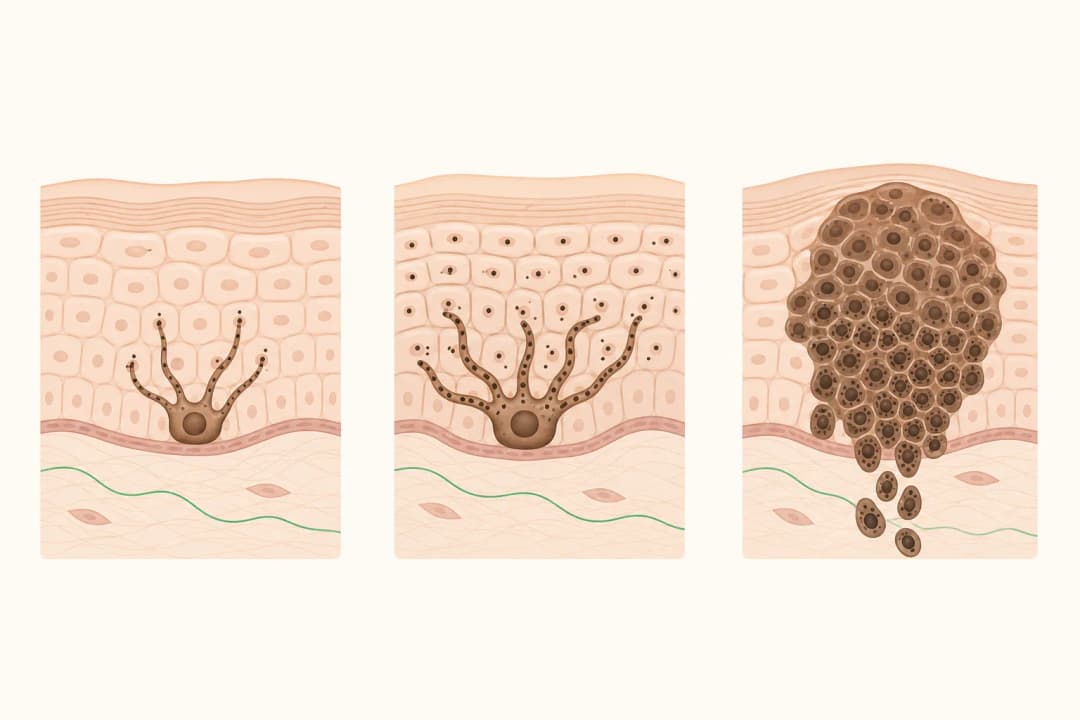
Visual asymmetry means one imaginary half does not broadly match the other. Clinicians assess the entire pattern, including pigment distribution, edges, surface and how the mark has evolved, rather than using a single feature as a diagnosis.
Melanoma can arise within an existing mole or appear as a new pigmented or non-pigmented growth. A dermatologist may inspect it with a dermatoscope and compare it with surrounding lesions. Definitive diagnosis generally requires removal of suspicious tissue for laboratory examination.
What to do if you notice asymmetry
Book a skin assessment rather than trying to classify the spot from an image or app. Record when you first noticed it and take a well-lit photograph with a size reference so change can be discussed. Mention previous skin cancers, significant sun exposure and relevant family history.
Do not cut, burn, freeze or apply bleaching products to the lesion. Altering it can injure the skin and make subsequent assessment more difficult. Protect the area from further sun exposure while awaiting the appointment.
When to arrange care
Arrange prompt medical review for a new or changing asymmetric lesion, a mark that looks different from the rest, or a spot that repeatedly bleeds, crusts, ulcerates, itches or hurts. These features warrant examination but do not by themselves establish melanoma.
If melanoma is diagnosed, the care team will discuss complete removal and whether further staging is appropriate. New neurological symptoms, severe breathlessness or rapidly worsening general health in someone with known melanoma require urgent medical advice.
Questions after examination
Ask which features are concerning, whether the whole lesion should be removed, how and when results will be communicated, what the report means for further surgery or staging, and how to monitor the rest of your skin between visits.
Find care
General Clinics & Polyclinics in Abu Dhabi
That answer is general. If you want it applied to your own case, these are licensed general clinics & polyclinics listed in Abu Dhabi.
27 Ar Ruwwad St - Shakhbout City - MSH4 - Abu Dhabi - United Arab Emirates
Accepts: Daman, Thiqa, Cigna, MetLife +20 more
Al Ruwais, Al Dhafrah
Accepts: Daman, Thiqa, AXA, Cigna +16 more
Al Bahyah - Al Bahyah Old - Abu Dhabi - United Arab Emirates
Accepts: Daman, Thiqa, Cigna, Allianz Care +18 more
Abu Dhabi
Accepts: Daman, Thiqa, AXA, Cigna +27 more
Ordered by verification status and how complete each clinic's public record is, then alphabetically. This is a directory listing, not a ranking — Zavis does not rate or recommend providers.
A factual listing drawn from the DHA, DOH and MOHAP licence registers. It is not a referral, an endorsement, or advice that any of these providers is right for you.
Questions people ask
Does an asymmetric mole mean melanoma?
No. Benign moles can be asymmetric, while melanoma has a range of appearances. The safe direction is that melanoma may show asymmetry; an asymmetric mole does not automatically indicate melanoma.
Can a symmetrical spot still be melanoma?
Yes, appearance varies and no single visual rule excludes melanoma. Change over time and a spot that differs from a person's other lesions also matter.
What happens if the dermatologist is concerned?
The clinician may recommend removing the lesion with a margin of skin so a pathology laboratory can examine it. Further management depends on the findings.
Related
Related reading
Keep reading
Medical disclaimer. This page is general health information, not medical advice, and it cannot diagnose you. Always consult a licensed healthcare provider about your own symptoms and treatment. In an emergency in the UAE, call 998 for an ambulance.