
Anal melanoma staging: what the assessment tells you
Short answer
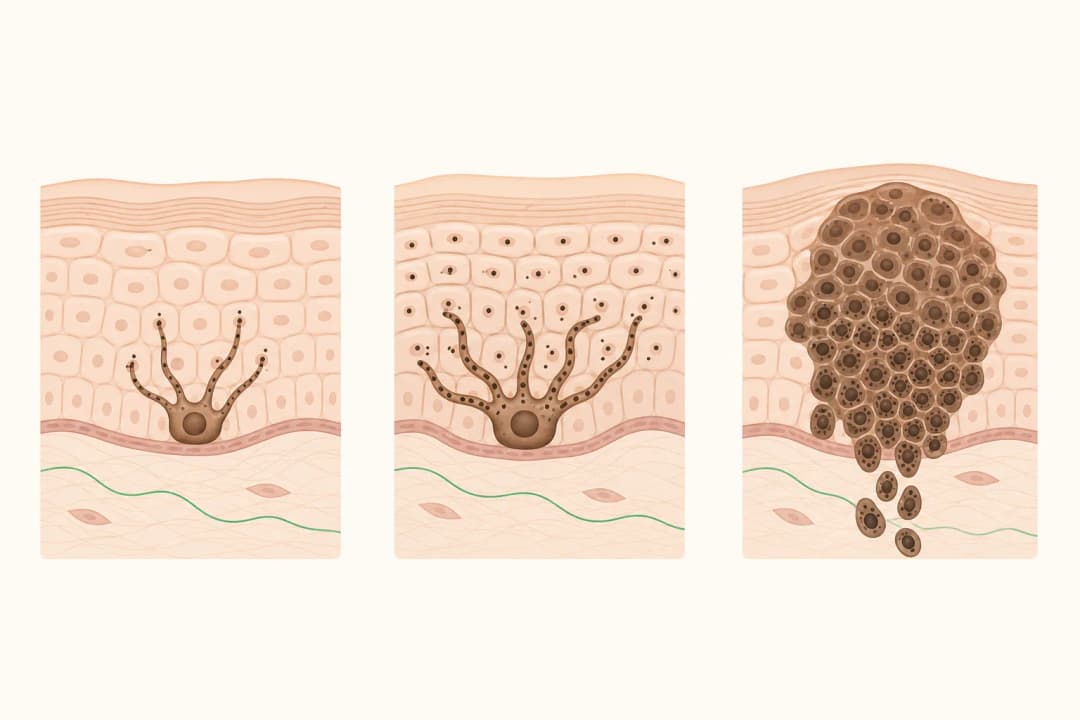
Anal melanoma staging describes how far the cancer has grown or spread, helping the specialist team choose and sequence appropriate treatment.
This answers one question. It is not a diagnosis and does not replace an assessment by a licensed doctor.
At a glance
- Main question
- Whether disease is local, in regional nodes or in distant organs
- Inputs
- Examination, pathology and imaging
- Purpose
- Treatment selection, sequencing and a baseline for follow-up
Staging in brief
The assessment looks at the tumour in the anal region, nearby lymph nodes and other parts of the body. A stage is assigned only after the available clinical, pathology and imaging information is brought together.
Information used to determine extent
The team reviews the biopsy to confirm melanoma and describe features of the sampled tissue. Examination may include the skin around the anus, the anal canal, rectum and accessible lymph-node areas. Imaging checks local structures, regional nodes and distant organs.
Staging language can vary because anal melanoma is a mucosal melanoma rather than the more familiar melanoma arising in sun-exposed skin. Ask which system the team is using and what the stated category means for your own tumour; comparing labels from different systems can be misleading.
Preparing for the staging process
Keep copies of the pathology report and each scan report, and tell the team about previous cancers, current medicines, allergies and any implanted devices before imaging. Report new symptoms even if they seem unrelated, since they may affect which body areas need closer assessment.
A lymph-node procedure may be considered in selected circumstances, but it is not automatically suitable for every patient. Once the work-up is complete, request a written summary of the stage, treatment goal, proposed sequence and any unanswered findings that still need clarification.
Changes to report during staging
Contact the cancer team promptly if bleeding increases, pain becomes difficult to control, bowel movements become obstructed, or a new groin swelling appears. New persistent headache, weakness, confusion, seizure, breathlessness, jaundice or severe bone pain also warrants rapid medical assessment.
Heavy bleeding, collapse, sudden neurological change or severe breathing difficulty needs emergency care. Urgency comes from the symptom and its effect on you; do not wait for a scheduled scan or appointment when an acute problem develops.
Make the stage understandable
Ask where disease has been found, which results remain pending, whether a scan finding is definite or uncertain, and whether more tissue testing is needed. Confirm how the stage changes the treatment choices and whether the case will be discussed by a multidisciplinary cancer team.
Find care
General Clinics & Polyclinics in Abu Dhabi
That answer is general. If you want it applied to your own case, these are licensed general clinics & polyclinics listed in Abu Dhabi.
27 Ar Ruwwad St - Shakhbout City - MSH4 - Abu Dhabi - United Arab Emirates
Accepts: Daman, Thiqa, Cigna, MetLife +20 more
Al Ruwais, Al Dhafrah
Accepts: Daman, Thiqa, AXA, Cigna +16 more
Al Bahyah - Al Bahyah Old - Abu Dhabi - United Arab Emirates
Accepts: Daman, Thiqa, Cigna, Allianz Care +18 more
Abu Dhabi
Accepts: Daman, Thiqa, AXA, Cigna +27 more
Ordered by verification status and how complete each clinic's public record is, then alphabetically. This is a directory listing, not a ranking — Zavis does not rate or recommend providers.
A factual listing drawn from the DHA, DOH and MOHAP licence registers. It is not a referral, an endorsement, or advice that any of these providers is right for you.
Questions people ask
Can the stage change after surgery?
Yes. Examination of removed tissue may provide details that were not visible on scans, so the team may refine the stage and treatment plan.
Does a scan alone determine the stage?
Usually the team combines scans with examination and pathology. Each source answers different questions about the primary tumour and possible spread.
Why might lymph nodes be assessed?
Regional lymph nodes can be a route of spread. Their assessment may use examination, imaging, needle sampling or a surgical procedure, depending on the situation.
Related
Related reading
Keep reading
Medical disclaimer. This page is general health information, not medical advice, and it cannot diagnose you. Always consult a licensed healthcare provider about your own symptoms and treatment. In an emergency in the UAE, call 998 for an ambulance.