
Alopecia Areata: A Primary-Care Approach
Short answer
An RACGP-related search usually seeks a primary-care approach: confirm the pattern, exclude look-alike conditions, assess impact, and tailor management.
This answers one question. It is not a diagnosis and does not replace an assessment by a licensed doctor.
At a glance
- First assessment
- Often begins in primary care
- Testing
- Guided by symptoms, history, and examination
- Referral
- Considered for uncertainty, extensive change, complex treatment, or substantial impact
Direct answer
A general practitioner can often begin this process by examining the scalp and other hair-bearing areas, looking at the nails, reviewing medicines and health history, and deciding whether tests, initial treatment, or dermatology referral are appropriate.
What a primary-care assessment covers
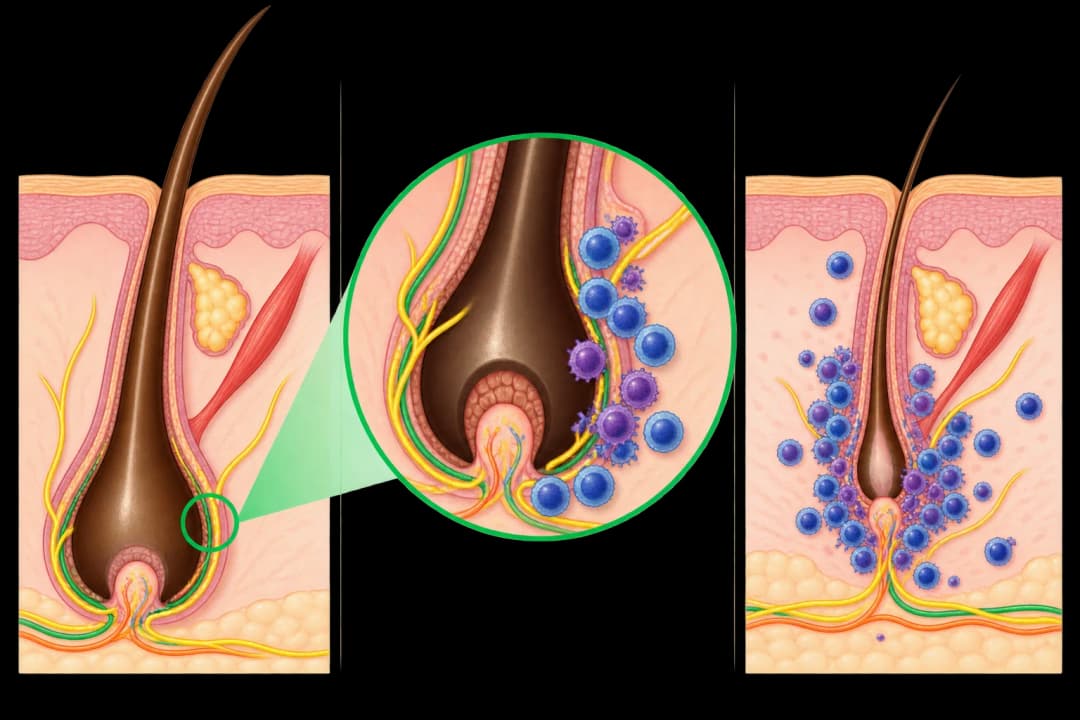
Classic alopecia areata presents with smooth, clearly outlined patches of non-scarring hair loss. Short tapering hairs near an active edge and small nail pits can support the diagnosis. Scale, crust, prominent redness, broken hairs, loss of follicle openings, or marked tenderness can direct attention toward fungal infection, trauma, inflammatory scalp disease, or scarring alopecia.
The consultation also considers the speed and extent of loss, eyebrow or eyelash involvement, previous episodes, family history, symptoms of other immune-related illness, and emotional burden. Blood tests are targeted to clinical clues; a broad panel is not automatically required for every person.
Management and follow-up
Limited patches may be observed or treated with corticosteroids applied to the skin or injected into affected areas. More extensive, rapidly changing, or persistent disease may require specialist discussion of medicines that affect the immune system. Age, pregnancy considerations, other conditions, medicine interactions, monitoring, and patient priorities shape the choice.
At home, handle remaining hair gently, protect bare scalp from sunlight, and photograph affected areas consistently. Agree on what improvement would look like and when to review progress. Cosmetic camouflage and psychological support are valid parts of management because visible hair loss can affect confidence and participation even when physical health is otherwise stable.
When to seek medical care
Seek assessment for any unexplained patchy hair loss rather than assuming the cause from photographs alone. Faster review is warranted for rapid progression, extensive loss, eyebrow or eyelash involvement, diagnostic uncertainty, or major distress. Pain, swelling, fever, drainage, heavy scale, crusting, or a shiny scar-like scalp requires prompt evaluation for another disorder.
Questions for your doctor
Ask what findings distinguish alopecia areata from fungal or scarring hair loss, whether targeted tests are indicated, and which first treatment matches the affected area. Discuss expected signs of response, potential side effects, the follow-up plan, and the circumstances in which a dermatology referral would add value.
Find care
General Clinics & Polyclinics in Abu Dhabi
That answer is general. If you want it applied to your own case, these are licensed general clinics & polyclinics listed in Abu Dhabi.
27 Ar Ruwwad St - Shakhbout City - MSH4 - Abu Dhabi - United Arab Emirates
Accepts: Daman, Thiqa, Cigna, MetLife +20 more
Al Ruwais, Al Dhafrah
Accepts: Daman, Thiqa, AXA, Cigna +16 more
Al Bahyah - Al Bahyah Old - Abu Dhabi - United Arab Emirates
Accepts: Daman, Thiqa, Cigna, Allianz Care +18 more
Abu Dhabi
Accepts: Daman, Thiqa, AXA, Cigna +27 more
Ordered by verification status and how complete each clinic's public record is, then alphabetically. This is a directory listing, not a ranking — Zavis does not rate or recommend providers.
A factual listing drawn from the DHA, DOH and MOHAP licence registers. It is not a referral, an endorsement, or advice that any of these providers is right for you.
Questions people ask
Can a GP diagnose alopecia areata?
A GP can often recognise a typical presentation and begin management. Unusual scalp findings, extensive loss, uncertainty, or the need for systemic treatment may prompt dermatology referral.
Are blood tests always needed?
No. A clinician selects tests when the history or examination suggests another condition or a relevant deficiency, and may also request monitoring linked to a particular medicine.
Why might the scalp need closer examination?
Magnified inspection can clarify whether follicle openings remain and whether hairs are tapering, broken, or inflamed. Those details help distinguish non-scarring alopecia areata from conditions needing different care.
Related
Related reading
Keep reading
Medical disclaimer. This page is general health information, not medical advice, and it cannot diagnose you. Always consult a licensed healthcare provider about your own symptoms and treatment. In an emergency in the UAE, call 998 for an ambulance.