
What Patients Should Know About Alopecia Areata
Short answer
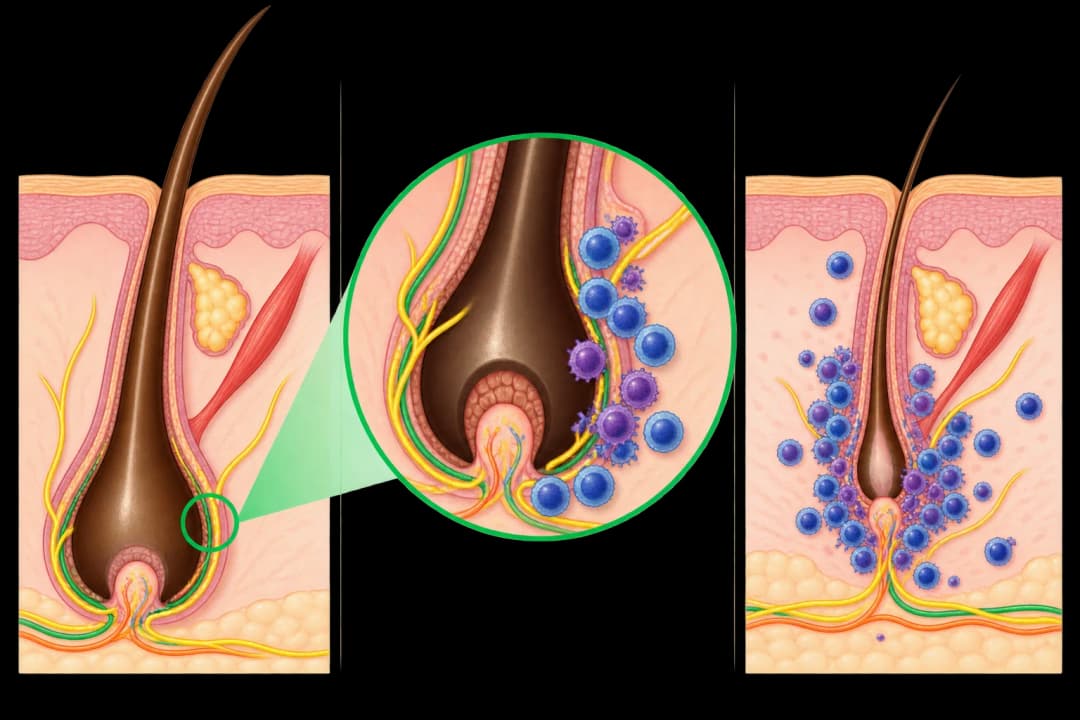
Patients with alopecia areata have immune-mediated, non-contagious hair loss that can change over time and deserves an individual care plan.
This answers one question. It is not a diagnosis and does not replace an assessment by a licensed doctor.
At a glance
- Contagious
- No
- Hair follicles
- Usually remain capable of producing hair
- Care approach
- Matched to extent, location, health history, and patient priorities
Direct answer
Hair may regrow in a patch while another area develops loss. The condition can affect scalp hair, eyebrows, eyelashes, facial hair, or other body hair, and some people develop small pits or roughness in their nails. It does not result from poor hygiene and cannot be passed to another person.
Understanding the diagnosis
A clinician often recognises alopecia areata by smooth, sharply defined patches and characteristic short hairs near their edges. A closer scalp examination helps rule out fungal infection, pulling, breakage, or a scarring form of hair loss. Blood tests are selected from the history and examination rather than being necessary for every patient.
The future course varies. Follicles remain capable of making hair, but regrowth can be uneven or have a different colour at first. Treatment aims to reduce the immune attack and encourage growth; it does not remove the tendency for later episodes.
Living with and treating hair loss
Protect exposed scalp with shade or a comfortable head covering, use gentle hair care, and avoid styles that pull on remaining hair. Cosmetic fibres, wigs, eyebrow products, or false lashes are personal options rather than medical necessities. Tell your clinician if hair loss is affecting mood, sleep, school, work, or social life so emotional support becomes part of care.
Treatment may involve corticosteroids placed on or injected into limited patches, while more extensive disease may lead to discussion of medicines that act throughout the body. The choice depends on age, affected areas, speed of change, medical history, pregnancy plans, monitoring needs, and patient preference.
When to seek medical care
Book an assessment for unexplained patchy or rapid hair loss, especially when eyebrows, eyelashes, nails, or large scalp areas are involved. Prompt review is appropriate if the scalp becomes painful, swollen, very red, scaly, crusted, or produces drainage, because those changes may indicate another process requiring different treatment.
Questions for your doctor
Consider asking how certain the diagnosis is, which areas should be photographed, what benefit and side effects are realistic for each option, and whether monitoring is needed. Clarify how long to try a chosen treatment before reassessment and what to do if new patches appear.
Find care
General Clinics & Polyclinics in Abu Dhabi
That answer is general. If you want it applied to your own case, these are licensed general clinics & polyclinics listed in Abu Dhabi.
27 Ar Ruwwad St - Shakhbout City - MSH4 - Abu Dhabi - United Arab Emirates
Accepts: Daman, Thiqa, Cigna, MetLife +20 more
Al Ruwais, Al Dhafrah
Accepts: Daman, Thiqa, AXA, Cigna +16 more
Al Bahyah - Al Bahyah Old - Abu Dhabi - United Arab Emirates
Accepts: Daman, Thiqa, Cigna, Allianz Care +18 more
Abu Dhabi
Accepts: Daman, Thiqa, AXA, Cigna +27 more
Ordered by verification status and how complete each clinic's public record is, then alphabetically. This is a directory listing, not a ranking — Zavis does not rate or recommend providers.
A factual listing drawn from the DHA, DOH and MOHAP licence registers. It is not a referral, an endorsement, or advice that any of these providers is right for you.
Questions people ask
Can hair grow back after alopecia areata?
Regrowth is possible because the follicles are usually not destroyed. Its timing and completeness vary, and a new episode can occur even after an area has filled in.
Is alopecia areata caused by stress?
Alopecia areata is an immune-mediated disorder. Some patients notice an episode near a stressful period, but stress is not a simple or necessary cause, and patients should not blame themselves.
Can I colour my hair during an episode?
Hair dye does not treat the condition and may irritate sensitive skin. If the scalp is inflamed, sore, or broken, pause chemical treatments and discuss safer timing with a clinician.
Related
Related reading
Keep reading
Medical disclaimer. This page is general health information, not medical advice, and it cannot diagnose you. Always consult a licensed healthcare provider about your own symptoms and treatment. In an emergency in the UAE, call 998 for an ambulance.