
The hair pull test in alopecia areata
Short answer
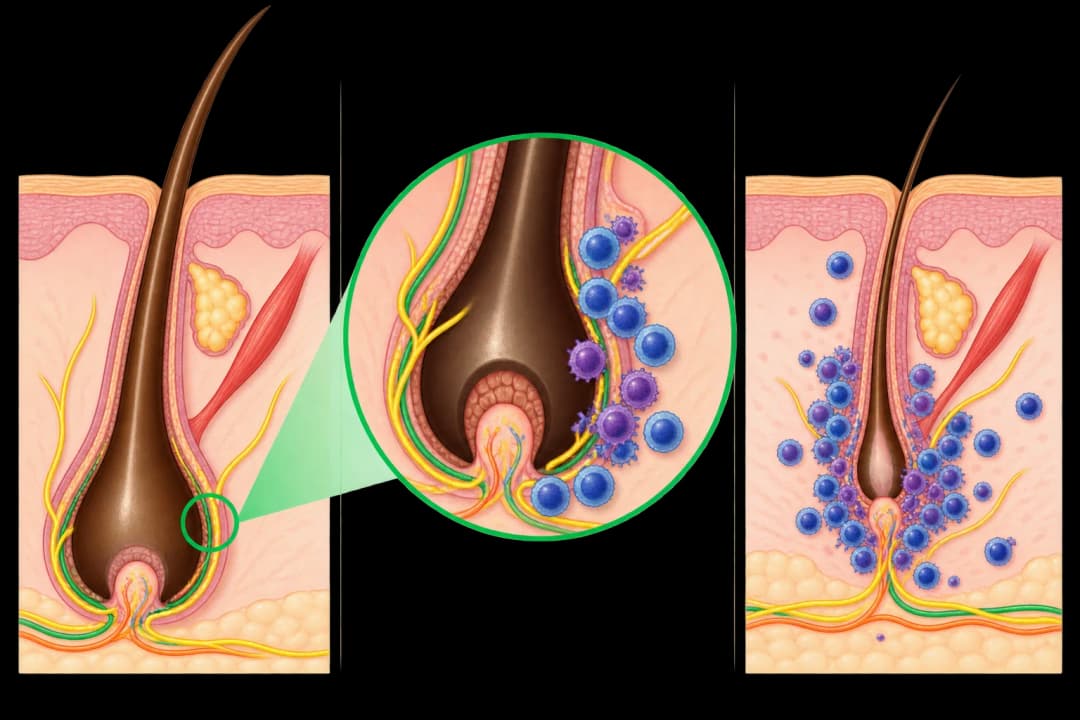
A hair pull test can show active shedding around alopecia areata patches, but it cannot confirm the diagnosis on its own.
This answers one question. It is not a diagnosis and does not replace an assessment by a licensed doctor.
At a glance
- Purpose
- The test checks whether hairs release easily with gentle traction.
- Meaning
- A positive result can support evidence of active shedding.
- Limit
- The test is not a stand-alone diagnosis.
What the test shows
During the examination, a clinician gently holds a small group of hairs and applies controlled traction. Hairs that release easily can indicate active loss in that area. The result must be interpreted alongside the patch shape, scalp surface, hair appearance, and medical history.
Understanding a positive or negative result
A positive test at the edge of a smooth bald patch can support the impression that alopecia areata is currently active. It does not measure future spread or tell whether hair will regrow. A negative test means hairs did not release readily at that moment; it does not rule out alopecia areata or prove that the episode has ended.
Hair washing, styling, recent shedding, and the exact area sampled can affect what is observed. Dermatologists may also use magnification to look for broken, tapered, or very short hairs and may check the nails, brows, lashes, and other scalp areas.
Prepare for a useful assessment
Do not repeatedly pull your own hair to monitor the condition; technique varies and repeated traction can break hairs or irritate the scalp. Instead, note when you first saw the patch, whether its border is changing, and whether hair is shedding elsewhere. Bring photographs and a list of medicines, supplements, recent illnesses, and hair treatments.
If the pattern is unclear, the clinician may examine hairs and scalp more closely or consider tests for other causes. Treatment decisions are based on the whole assessment rather than the pull test alone.
Signs that need review
Arrange an appointment for sudden patchy loss, continued expansion, widespread shedding, or loss from eyebrows or eyelashes. Prompt evaluation is appropriate if the scalp is tender, inflamed, heavily scaly, scarred, or producing discharge, since these findings call for assessment beyond a simple hair pull test.
Discussion points for the visit
Ask where the test was positive, what other examination findings support the diagnosis, and whether another cause of shedding is possible. Clarify how activity will be monitored, which changes should bring you back sooner, and how the test result affects any proposed treatment.
Find care
General Clinics & Polyclinics in Abu Dhabi
That answer is general. If you want it applied to your own case, these are licensed general clinics & polyclinics listed in Abu Dhabi.
27 Ar Ruwwad St - Shakhbout City - MSH4 - Abu Dhabi - United Arab Emirates
Accepts: Daman, Thiqa, Cigna, MetLife +20 more
Al Ruwais, Al Dhafrah
Accepts: Daman, Thiqa, AXA, Cigna +16 more
Al Bahyah - Al Bahyah Old - Abu Dhabi - United Arab Emirates
Accepts: Daman, Thiqa, Cigna, Allianz Care +18 more
Abu Dhabi
Accepts: Daman, Thiqa, AXA, Cigna +27 more
Ordered by verification status and how complete each clinic's public record is, then alphabetically. This is a directory listing, not a ranking — Zavis does not rate or recommend providers.
A factual listing drawn from the DHA, DOH and MOHAP licence registers. It is not a referral, an endorsement, or advice that any of these providers is right for you.
Questions people ask
Does the hair pull test hurt?
It uses gentle traction and should not involve forceful pulling, though an irritated scalp may feel sensitive.
Can I perform the test at home?
A home attempt is difficult to standardise and easy to misread. Photographs and notes about change are more useful for your appointment.
Does a negative test exclude active hair loss?
No. Sampling, timing, and the condition's pattern all influence the result, so the wider examination remains necessary.
Related
Related reading
Keep reading
Medical disclaimer. This page is general health information, not medical advice, and it cannot diagnose you. Always consult a licensed healthcare provider about your own symptoms and treatment. In an emergency in the UAE, call 998 for an ambulance.