
Can alopecia areata spread?
Short answer
Alopecia areata can remain limited, regrow, or involve additional hair-bearing areas, and its course is difficult to predict from one patch alone.
This answers one question. It is not a diagnosis and does not replace an assessment by a licensed doctor.
At a glance
- Contagious
- No; it cannot pass through touch or shared objects
- Possible course
- Patches may stay stable, regrow, enlarge, or appear elsewhere
- Useful record
- Comparable photographs can show change more clearly
The short answer
The condition does not spread by touch and is not contagious. Apparent spreading can mean that an existing patch is widening, separate patches are appearing, or nearby patches are joining.
How the pattern can change
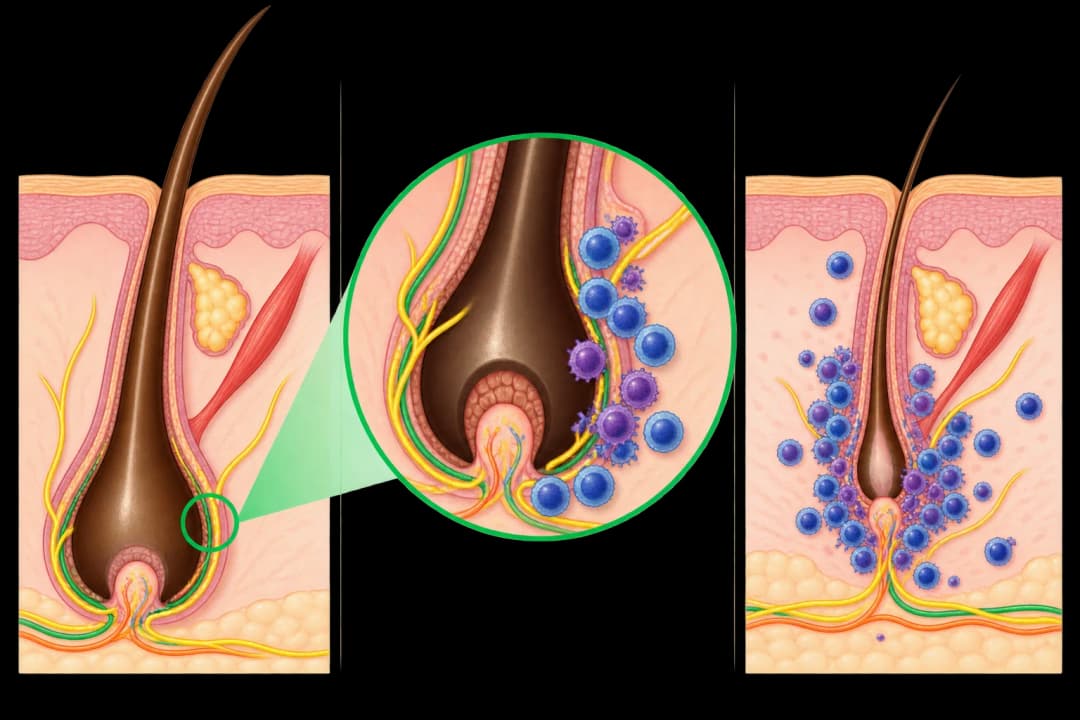
Alopecia areata is an immune-mediated condition in which inflammation disrupts normal hair growth without destroying the follicle. Activity may settle in one place while starting elsewhere, so regrowth and new loss can occur at the same time.
New smooth patches may arise on the scalp, beard, eyebrows, eyelashes, or other body areas. More extensive patterns can occur, but the size of the first patch does not provide a certain forecast. Short broken hairs at an edge may suggest activity; soft pale hairs within a patch can be an early sign of return.
What you can do now
Take photographs in similar lighting with the hair parted the same way, and note new areas rather than repeatedly pulling at patch edges. Handle remaining hair gently and protect exposed scalp from strong sunlight with a hat or suitable sunscreen.
Arrange a clinical review to confirm that the changing pattern is alopecia areata, since fungal infection, traction, hair pulling, and scarring disorders require different care. A dermatologist can assess activity, the amount of involvement, age, health conditions, and treatment preferences before discussing topical medicine, injections, or systemic treatment.
Changes that need prompt attention
Seek timely medical assessment if hair loss is rapidly expanding, affects eyelashes around the eyes, or is causing substantial distress. Pain, pus, crusting, strong redness, fever, or a boggy swollen area are not typical features of uncomplicated alopecia areata and need prompt evaluation.
Also book a review if the skin looks shiny or scarred, follicle openings seem absent, or loss follows a tight hairstyle pattern. These signs can indicate another form of hair loss in which early diagnosis matters.
Questions for your clinician
Ask whether the edges appear active, whether other hair-bearing areas and nails should be examined, and how you should photograph progress. Useful treatment questions include what outcome is realistic, how response will be checked, and which side effects should lead you to stop a medicine and contact the clinic.
Find care
General Clinics & Polyclinics in Abu Dhabi
That answer is general. If you want it applied to your own case, these are licensed general clinics & polyclinics listed in Abu Dhabi.
27 Ar Ruwwad St - Shakhbout City - MSH4 - Abu Dhabi - United Arab Emirates
Accepts: Daman, Thiqa, Cigna, MetLife +20 more
Al Ruwais, Al Dhafrah
Accepts: Daman, Thiqa, AXA, Cigna +16 more
Al Bahyah - Al Bahyah Old - Abu Dhabi - United Arab Emirates
Accepts: Daman, Thiqa, Cigna, Allianz Care +18 more
Abu Dhabi
Accepts: Daman, Thiqa, AXA, Cigna +27 more
Ordered by verification status and how complete each clinic's public record is, then alphabetically. This is a directory listing, not a ranking — Zavis does not rate or recommend providers.
A factual listing drawn from the DHA, DOH and MOHAP licence registers. It is not a referral, an endorsement, or advice that any of these providers is right for you.
Questions people ask
Does one patch mean I will lose all my hair?
No. A single patch cannot predict the eventual extent; alopecia areata varies considerably between people and over time.
Can I make alopecia areata spread by brushing or washing?
Normal washing and gentle brushing do not transmit the condition. Hairs already affected at the root may release during routine care.
Can a patch grow hair while another patch appears?
Yes. Different follicles can be at different stages, so recovery in one area can coincide with activity in another.
Related
Related reading
Keep reading
Medical disclaimer. This page is general health information, not medical advice, and it cannot diagnose you. Always consult a licensed healthcare provider about your own symptoms and treatment. In an emergency in the UAE, call 998 for an ambulance.