
What should you know about age for melanoma?
Short answer
Melanoma becomes more relevant with accumulated sun exposure and advancing age, but it can develop in younger adults too.
This answers one question. It is not a diagnosis and does not replace an assessment by a licensed doctor.
At a glance
- Age rule
- Suspicious change matters at any age
- Key clue
- A lesion that is new or evolving
- Assessment
- Skin examination with dermoscopy when appropriate
Melanoma and age
There is no age at which a suspicious lesion can safely be dismissed. A clinician considers age alongside the lesion's appearance, personal and family history, skin type, sun exposure and previous skin cancers.
How to interpret age
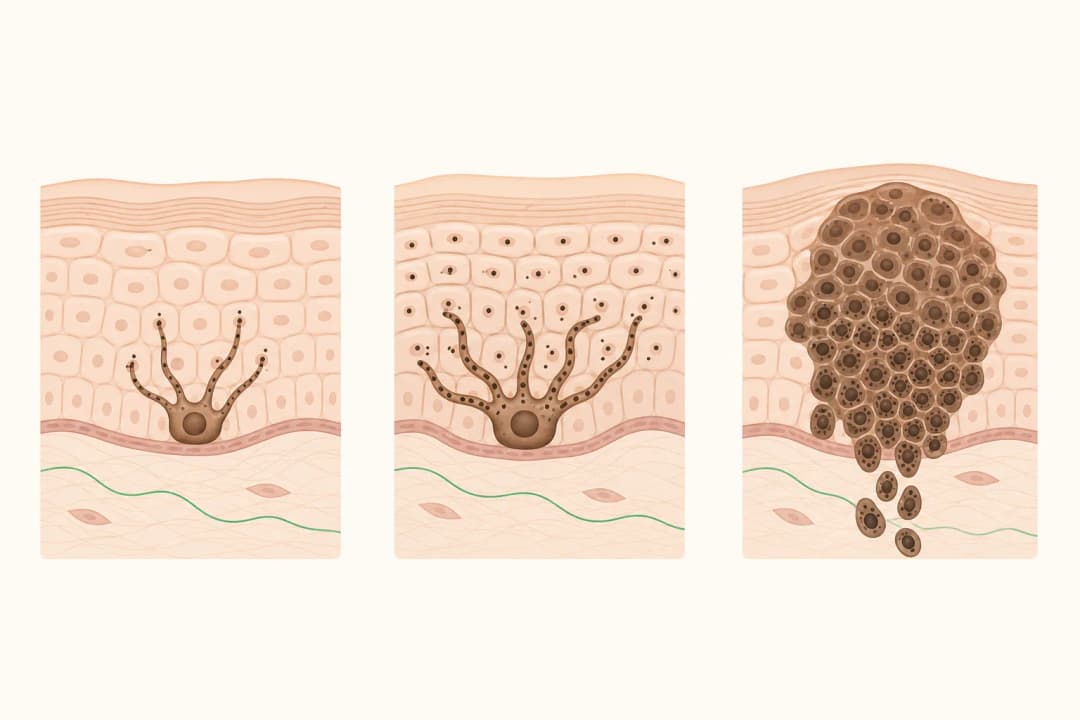
Melanoma is a cancer of pigment-producing cells. It may arise in an existing mole or appear as a new mark, including on skin that is not regularly exposed to sunlight. Older age can add to the clinical context because ultraviolet damage accumulates, yet age alone neither confirms nor excludes melanoma.
Melanoma may present with a new or changing pigmented lesion, but many moles and marks are benign. Assessment focuses on asymmetry, irregular borders, uneven colour, growth and continuing change rather than assuming what a mark means.
Check and protect your skin
Become familiar with your own skin so that a new or evolving lesion is easier to notice. Check less visible sites such as the scalp, back, soles, between the toes and beneath nails, using a mirror or help from someone you trust.
Reduce ultraviolet exposure with shade, protective clothing and suitable broad-spectrum sunscreen. Photographs with a date can help show change, but an image or phone application cannot replace examination and dermoscopy by a trained clinician.
Changes that need assessment
Book a prompt skin assessment for a new or changing mole or mark, especially one becoming asymmetric, irregular at the edge, varied in colour, larger, raised or different from your other lesions. A sore that does not heal also needs review.
Seek faster medical attention if a lesion bleeds without clear injury, ulcerates, grows rapidly or is accompanied by a new lump in a nearby lymph-node area. Do not delay because you feel too young or because the mark is small.
Planning the consultation
Ask whether the lesion needs dermoscopy, photography, removal or biopsy, and how soon each step should happen. If melanoma is diagnosed, useful questions cover tumour depth, whether further surgery or lymph-node assessment is advised, and the schedule for skin and scar checks.
Find care
General Clinics & Polyclinics in Abu Dhabi
That answer is general. If you want it applied to your own case, these are licensed general clinics & polyclinics listed in Abu Dhabi.
27 Ar Ruwwad St - Shakhbout City - MSH4 - Abu Dhabi - United Arab Emirates
Accepts: Daman, Thiqa, Cigna, MetLife +20 more
Al Ruwais, Al Dhafrah
Accepts: Daman, Thiqa, AXA, Cigna +16 more
Al Bahyah - Al Bahyah Old - Abu Dhabi - United Arab Emirates
Accepts: Daman, Thiqa, Cigna, Allianz Care +18 more
Abu Dhabi
Accepts: Daman, Thiqa, AXA, Cigna +27 more
Ordered by verification status and how complete each clinic's public record is, then alphabetically. This is a directory listing, not a ranking — Zavis does not rate or recommend providers.
A factual listing drawn from the DHA, DOH and MOHAP licence registers. It is not a referral, an endorsement, or advice that any of these providers is right for you.
Questions people ask
Can a young adult develop melanoma?
Yes. Melanoma can occur in young adults, so age should not be used to dismiss a changing or unusual lesion.
Does an older age prove that a dark mark is melanoma?
No. Many dark marks are benign. Diagnosis depends on clinical examination and, when needed, analysis of a tissue sample.
Can melanoma be colourless?
Yes. Some melanomas contain little obvious pigment and may look pink or red, making persistent growth or change especially relevant.
Related
Related reading
Keep reading
Medical disclaimer. This page is general health information, not medical advice, and it cannot diagnose you. Always consult a licensed healthcare provider about your own symptoms and treatment. In an emergency in the UAE, call 998 for an ambulance.