
Adductor Strain Treatment
Short answer
Adductor strain treatment starts with protecting the injured groin, then progressively restores movement, strength and sport-specific function.
This answers one question. It is not a diagnosis and does not replace an assessment by a licensed doctor.
At a glance
- Main area
- Inner thigh and groin
- Early priority
- Protect the area while keeping comfortable movement
- Progression
- Strength, control, running and sport-specific drills
The short answer
Early care focuses on stopping movements that sharply increase pain rather than forcing a stretch. As walking and everyday tasks settle, rehabilitation can add controlled adductor exercises, hip and trunk strengthening, and gradual changes of direction. The plan should respond to symptoms and function, not a fixed calendar alone.
What an adductor strain involves
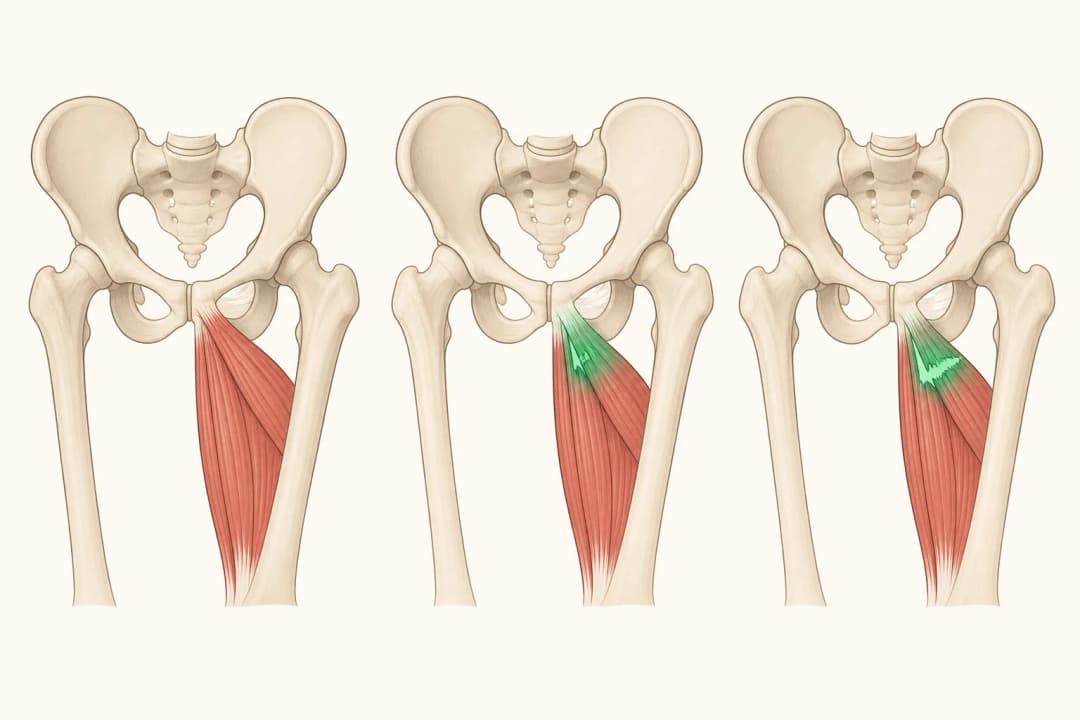
The adductors run along the inner thigh and help draw the leg inward, steady the pelvis and control cutting or kicking. A strain damages muscle fibres or the muscle-tendon junction, often during a sudden push, sprint or direction change. Pain may be felt in the inner thigh or groin and can increase when squeezing the knees together.
An examination can check the painful location, strength, hip movement and ability to walk. Imaging is not automatically needed, but a clinician may consider it after major trauma, marked weakness or an uncertain diagnosis.
How to manage recovery
Reduce running, kicking, deep side lunges and rapid cutting while they provoke sharp pain. Comfortable walking and gentle hip movement can help maintain mobility. A physiotherapist can progress from low-load isometric squeezes to resisted adduction, single-leg control and faster drills. Increase only one demanding element at a time, such as distance, speed or direction changes.
Return to training should include pain-controlled strength, confident acceleration and deceleration, and the movements required by your sport. A sudden pain-free day is not by itself proof that the tissue is ready for full competition.
When to seek medical care
Arrange an assessment if pain is worsening, repeatedly returns, limits normal walking or is not improving with activity changes. Seek urgent care after a forceful injury if you cannot bear weight, notice major swelling or deformity, or felt a snap followed by substantial weakness. Immediate assessment is also appropriate for groin pain with a painful lump, severe testicular pain, fever, numbness or abdominal symptoms because these features may have another cause.
Questions to discuss
Ask which structure appears injured, whether another hip or groin problem needs consideration, and what level of discomfort is acceptable during exercise. It is also useful to clarify which strength or movement checks will guide progression and how practice should be modified before unrestricted sport.
Find care
General Clinics & Polyclinics in Abu Dhabi
That answer is general. If you want it applied to your own case, these are licensed general clinics & polyclinics listed in Abu Dhabi.
27 Ar Ruwwad St - Shakhbout City - MSH4 - Abu Dhabi - United Arab Emirates
Accepts: Daman, Thiqa, Cigna, MetLife +20 more
Al Ruwais, Al Dhafrah
Accepts: Daman, Thiqa, AXA, Cigna +16 more
Al Bahyah - Al Bahyah Old - Abu Dhabi - United Arab Emirates
Accepts: Daman, Thiqa, Cigna, Allianz Care +18 more
Abu Dhabi
Accepts: Daman, Thiqa, AXA, Cigna +27 more
Ordered by verification status and how complete each clinic's public record is, then alphabetically. This is a directory listing, not a ranking — Zavis does not rate or recommend providers.
A factual listing drawn from the DHA, DOH and MOHAP licence registers. It is not a referral, an endorsement, or advice that any of these providers is right for you.
Questions people ask
Should I stretch an adductor strain straight away?
Avoid forceful stretching when it reproduces sharp pain. Gentle, comfortable movement may be introduced first, with flexibility work progressed according to symptoms and clinical advice.
Can I keep training with a strained adductor?
Training often needs modification. Activities that do not increase pain during or after the session may be suitable, while sprinting, kicking and cutting are rebuilt gradually.
Does every adductor strain need a scan?
No. Clinical assessment is often enough, although imaging may help when the injury is severe, the diagnosis is unclear or progress is unexpected.
Related
Related reading
Keep reading
Medical disclaimer. This page is general health information, not medical advice, and it cannot diagnose you. Always consult a licensed healthcare provider about your own symptoms and treatment. In an emergency in the UAE, call 998 for an ambulance.