
Meniscus Repair: Surgery and Recovery
At a glance
- Joint treated
- Knee
- Surgical approach
- Arthroscopic, through small portals
- Rehabilitation focus
- Protected healing followed by progressive loading
Find care
Hospitals & Medical Centers in Abu Dhabi
Licensed hospitals & medical centers listed in Abu Dhabi. Appearing here means a provider holds a UAE licence in this category — not that it offers meniscus repair: surgery and recovery, which is worth confirming with the clinic before you book.
Ahalia Hospital Musaffah Building - Musaffah - Musaffah Industrial - Abu Dhabi - United Arab Emirates
Accepts: Daman, Thiqa, AXA, Cigna +26 more
Al Ruwais Industrial City - Abu Dhabi - United Arab Emirates
Accepts: Daman, Thiqa, AXA, Cigna +30 more
Abu Dhabi, Abu Dhabi
Accepts: Daman, Thiqa, AXA, Cigna +30 more
Plot No. 11-12, SE 44 Khalifa City A - مدينة خليفة - جنوب شرق 44 - أبو ظبي - United Arab Emirates
Accepts: Daman, Thiqa, AXA, Cigna +26 more
7 Al Kawadir 2 St - Khalifa City - SE44 - Abu Dhabi - United Arab Emirates
Accepts: Daman, Thiqa, AXA, Cigna +25 more
Mohammed Bin Khalif Street 669, Al Mussala, Abu Dhabi, Abu Dhai - 35453 - 669 Mohammed Bin Khalifa St - Al Manhal - W15 02 - Abu Dhabi - United Arab Emirates
Accepts: Daman, Thiqa, AXA, Cigna +22 more
Ordered by verification status and how complete each clinic's public record is, then alphabetically. This is a directory listing, not a ranking — Zavis does not rate or recommend providers.
A factual listing drawn from the DHA, DOH and MOHAP licence registers. It is not a referral, an endorsement, or advice that any of these providers is right for you.
What is meniscus repair?
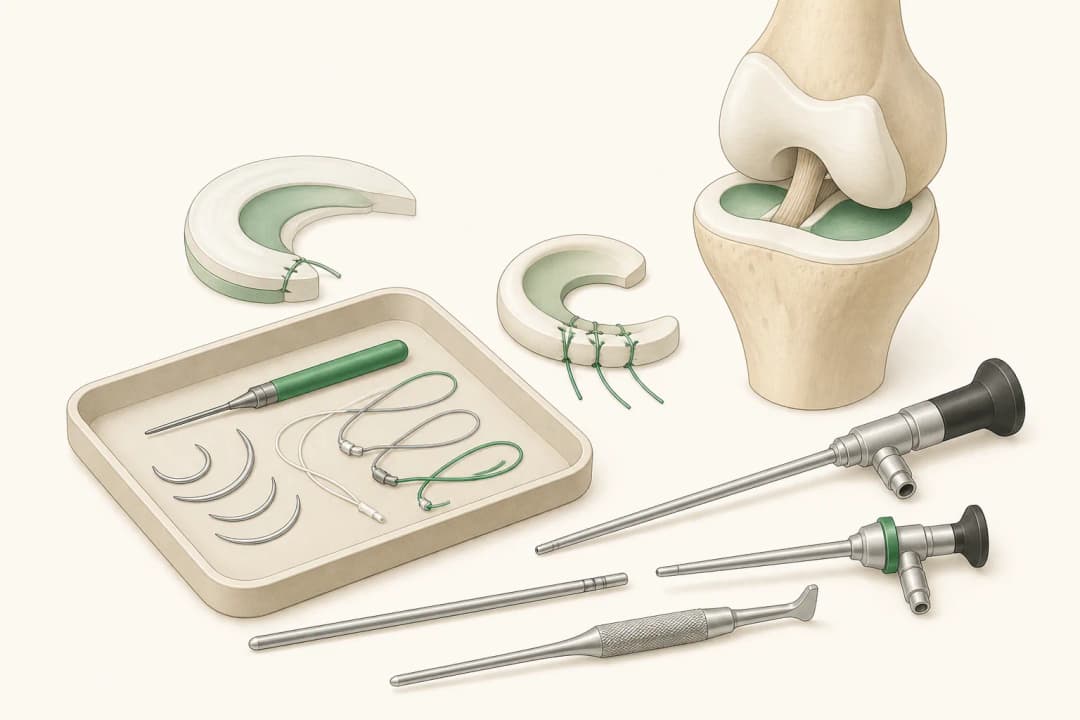
Meniscus repair is keyhole knee surgery that stitches a suitable torn meniscus so the tissue can heal while rehabilitation gradually restores movement and strength.
The menisci are pads of cartilage between the thighbone and shinbone. They help distribute load and support knee movement. Repair is considered when the tear's location, pattern, tissue quality, and blood supply make healing plausible. An orthopaedic surgeon confirms the plan using your examination and imaging, while also considering symptoms, activity goals, and other knee damage.
What does recovery actually involve?
Recovery usually involves a protected early phase followed by steadily increasing movement, weight bearing, strength, balance, and task-specific training. A brace or crutches may be used when advised, and knee bending or loading can be limited at first to protect the repair. Physiotherapy then progresses exercises according to swelling, control, strength, and the demands of work or sport. The timetable is individual, so clearance for twisting, running, or competition should come from the surgical and rehabilitation team.
What can go wrong, and how often?
Possible problems include infection, bleeding, blood clots, stiffness, persistent swelling, nerve or blood-vessel irritation, or failure of the meniscus to heal. Symptoms may also come from cartilage or ligament damage that was present at the original injury. Your surgeon should explain which risks apply to your health and operation, how warning signs are handled, and when follow-up occurs. This page does not assign a frequency to complications.
Will it fix the problem, and for how long?
Repair aims to preserve meniscal tissue and relieve symptoms caused by the tear, but it cannot guarantee a symptom-free knee or prevent every future problem. Durability depends on tear characteristics, healing, rehabilitation, alignment, and later loading. Ongoing locking, giving way, swelling, or pain after recovery deserves reassessment rather than assuming the operation has failed.
Key facts
Repair preserves more of the natural meniscus than removing the damaged portion, but it asks for a more protective rehabilitation period. Not every tear can be stitched. The surgeon may inspect the whole joint and treat findings according to the agreed plan.
Who may be considered?
Repair may be discussed for a person with symptoms and a tear that appears technically repairable, especially when preserving meniscal tissue supports future knee function. It is not selected from a scan alone. A consultation considers the history, examination, imaging, age and activity context, previous treatment, and whether the symptoms match the [Meniscus Tear](/conditions/meniscus-tear/).
What happens during surgery?
The operation commonly involves these stages:
1. The knee is assessed under anaesthesia and small portals are prepared. 2. An [Arthroscope](/technology/arthroscope/) sends a camera image into the joint. 3. The surgeon checks the meniscus and nearby cartilage and ligaments. 4. The tear is prepared and stabilised with sutures, sometimes using a [Suture Anchor](/materials/suture-anchor/) where appropriate. 5. The instruments are removed, the portals are closed, and a postoperative plan covers protection, pain control, wound care, and rehabilitation.
Recovery milestones
Early recovery centres on wound care, swelling control, safe transfers, and the permitted knee range. The next phase rebuilds quadriceps control, gait, and functional strength. Later rehabilitation adds balance, hopping, running, cutting, and sport-specific drills only when testing shows adequate control. A [Return-to-Sport Programme](/treatments/physiotherapy-and-rehabilitation/return-to-sport-programme/) can structure that progression.
Warning signs after surgery
Contact the surgical team about increasing redness or drainage, fever, worsening calf pain or swelling, uncontrolled pain, or a wound that opens. Seek urgent help for chest pain, sudden breathlessness, or a new cold, pale, or severely painful foot. Follow the discharge instructions for medication and activity because individual risks differ.
Possible alternatives
Depending on the tear and symptoms, options may include physiotherapy, activity modification, medication advice, observation, or removal of only unstable damaged tissue. That last option is called [Partial Meniscectomy](/treatments/sports-and-arthroscopic-surgery/partial-meniscectomy/). The choice balances tissue preservation, mechanical symptoms, healing potential, and your goals.
Finding the right team
Choose an orthopaedic service that explains why repair is suitable, what restrictions are expected, and how rehabilitation will be coordinated. Before consent, ask who will review your wound, how physiotherapy is arranged, what milestones guide progression, and which symptoms need urgent contact.
Questions people ask
Will I need crutches after meniscus repair?
Many patients use crutches for a period set by the surgeon, depending on the repair and allowed weight bearing.
When can I return to sport?
Return is based on healing, strength, movement quality, and sport-specific testing rather than a calendar date alone.
Can every meniscus tear be repaired?
No. Tear position, pattern, tissue quality, chronicity, and associated knee findings determine whether stitching is sensible.
Related
Related reading
Keep reading
Medical disclaimer. This page is general health information, not medical advice, and it cannot diagnose you. Always consult a licensed healthcare provider about your own symptoms and treatment. In an emergency in the UAE, call 998 for an ambulance.