
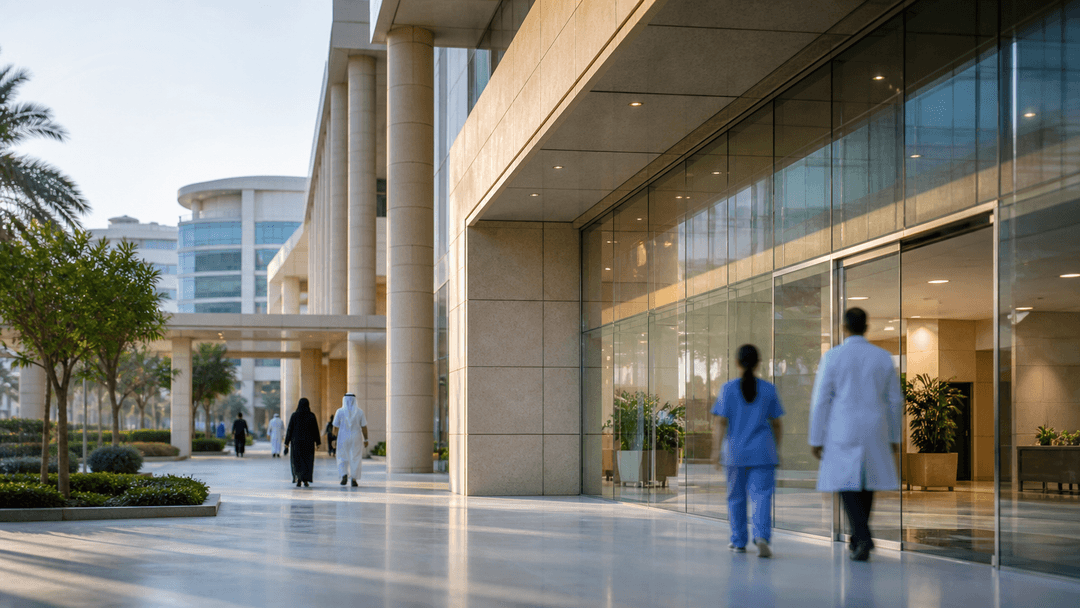
University Hospital Sharjah’s AED 300m expansion puts 72 beds into Dubai’s catchment
The Sharjah project is a capacity and referral signal for Dubai operators. The useful number is AED 4.17m per added bed before scope adjustments.
How Zavis verifies this coverage
Editorial standards, source rules, methodology, and review provenance are public.
For Dubai hospital CEOs and CFOs, the useful reading of the University Hospital Sharjah expansion is this: a publicly backed AED 300 million project is adding 72 beds, 14 ICU rooms and 300 parking spaces inside a commuter market that overlaps with Dubai’s northern catchment.
The Sharjah Executive Council reviewed the hospital’s operational projects on 1 September 2026, according to UAE Barq. The review covered the automated pharmacy, the hospital building expansion, a Physiotherapy Building, an Elderly Care Centre, interventional radiology expansion, equipment upgrades and electronic systems. That makes the project relevant to Dubai operators regulated by the Dubai Health Authority (DHA), because Sharjah capacity can pull insured patients, physicians and referral flows across the border.
The numbers that matter
The project was ordered on 17 June 2026 by Sheikh Dr Sultan bin Mohammed Al Qasimi, Ruler of Sharjah, at a stated cost of AED 300 million, according to University Hospital Sharjah. Gulf News reported that the expansion will add 72 doctors’ rooms, 22 assessment rooms, 48 standard patient rooms with 72 beds, 14 intensive care rooms, a helipad and 300 parking spaces.
The headline ratio is AED 4.17 million per added bed if the full AED 300 million is divided by 72 beds. That is a screening metric for CFOs, since the scope also includes outpatient rooms, assessment rooms, ICU rooms, parking, a helipad, equipment and systems. A Dubai operator benchmarking a brownfield ward, ICU or day-surgery expansion should ask bidders to separate shell-and-core works, MEP, medical equipment, IT, parking and commissioning costs before comparing the Sharjah ratio with its own capex plan.
- AED 300 million: stated project cost.
- 72 beds: added bed capacity reported for the new building.
- 14 ICU rooms: critical-care capacity with potential referral impact.
- 300 parking spaces: access capacity, taking total parking above 1,200 spaces, according to Gulf News.
Why Dubai operators should care
The competitive issue for Dubai is patient leakage at the northern edge of the emirate. A patient in Al Nahda, Muhaisnah, Mirdif or Dubai Silicon Oasis can reach parts of Sharjah faster than central Dubai at peak times. If University Hospital Sharjah pairs new capacity with shorter booking windows in physiotherapy, elderly care, interventional radiology or ICU step-down, Dubai providers may feel the change first in outpatient conversion and elective referrals.
The regulatory map matters. DHA regulates Dubai facilities. The Department of Health Abu Dhabi (DOH) regulates Abu Dhabi and Al Ain. The Ministry of Health and Prevention (MOHAP) is the federal reference for the Northern Emirates, including Sharjah, while Sharjah health policy also involves local authorities such as the Sharjah Health Authority. Dubai operators should treat the project as a cross-border market signal rather than a DHA licensing event.
For COOs, the operational question is timing. The September SEC review confirms the project has moved beyond a June instruction into government follow-up, but public disclosures reviewed by Zavis do not give a completion date. The practical step is to monitor four documents: construction tenders, equipment tenders, clinical licensing updates and recruitment notices. Those will show when capacity becomes real supply.
What to do with the signal
Finance teams should test two cases for 2027 and 2028: a base case where Sharjah adds capacity without changing Dubai referral flows, and a downside case where high-margin outpatient diagnostics, physiotherapy and elderly-care volumes shift by payer and postcode. Medical directors should watch interventional radiology and ICU staffing, because these services compete on senior consultants, anaesthesia cover and transfer pathways.
CIOs should pay attention to the automated pharmacy and electronic-systems upgrade. Those details point to procurement in medication management, patient registration, clinical documentation and data-entry workflow. Dubai hospitals with older pharmacy automation or fragmented registration systems should expect procurement teams and clinical staff to use the Sharjah project as a comparison point during 2027 budget rounds.
The next hard numbers to find are the construction award value, equipment package value, completion date, licensed bed count after commissioning and payer network status. Until those are public, the deal should be read as a funded capacity signal with a clear Dubai implication: benchmark cost per bed, map border-area patient flows and protect the specialties most exposed to Sharjah access gains. To compare licensed hospitals and providers by emirate, use the UAE Open Healthcare Directory.
Zavis Intelligence
Healthcare Industry Desk
Contributing to UAE healthcare industry coverage
Related coverage



FAQ
What is happening in UAE healthcare industry?
The Sharjah project is a capacity and referral signal for Dubai operators. The useful number is AED 4.17m per added bed before scope adjustments.