
What should you know about myeloproliferative neoplasm types?
Short answer
Myeloproliferative neoplasms are blood cancers grouped by the blood cell line that grows abnormally and the disease pattern.
This answers one question. It is not a diagnosis and does not replace an assessment by a licensed doctor.
At a glance
- Classic types
- Polycythaemia vera, essential thrombocythaemia, and primary myelofibrosis
- Assessment
- Blood patterns, examination, molecular testing, and sometimes marrow testing
- Care
- Monitoring, symptom control, targeted therapy, or transfusion support
The main groups
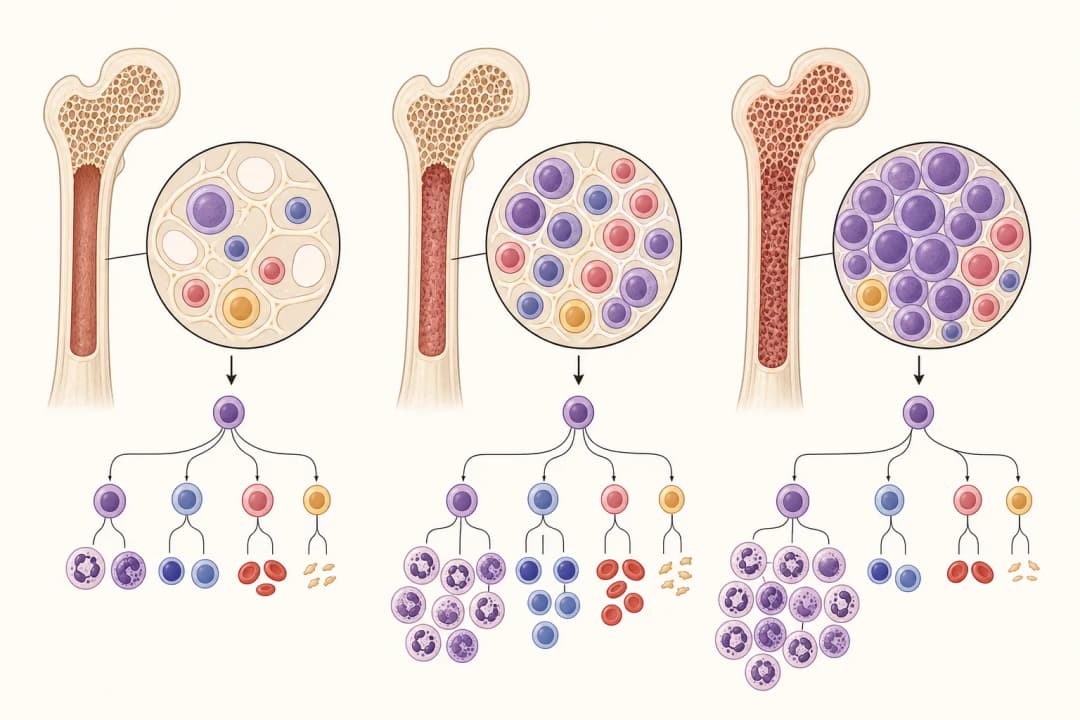
The main classic types are polycythaemia vera, essential thrombocythaemia, and primary myelofibrosis. Polycythaemia vera produces too many red blood cells; essential thrombocythaemia mainly raises platelet production; and primary myelofibrosis causes marrow scarring with abnormal blood production. Chronic myeloid leukaemia is another myeloproliferative neoplasm with a distinct genetic pattern.
Symptoms and blood counts can overlap. Some people have headaches, itching, night sweats, tiredness, abdominal fullness from an enlarged spleen, bleeding, or clotting. A blood result does not identify the type by itself; clinicians combine the count pattern with examination, molecular tests, and sometimes a marrow biopsy.
How assessment guides care
Bring previous blood results and a list of medicines, especially blood thinners. Ask whether testing will include mutation analysis, marrow examination, or spleen assessment. Treatment depends on the subtype, symptoms, blood counts, clotting or bleeding history, and risk of progression.
Care may include observation with regular monitoring, targeted therapy, medicines that reduce abnormal blood-cell production, or blood transfusion support when blood counts fall. A specialist can explain why one approach fits your pattern.
When to seek urgent care
Seek emergency help for sudden weakness on one side, trouble speaking, severe chest pain, new breathlessness, a painful swollen leg, severe headache, or heavy bleeding. Contact your clinical team promptly for fever, worsening abdominal fullness, or rapidly increasing tiredness.
Questions for your doctor
Ask which subtype is suspected, which result confirms it, how often counts will be checked, and what symptoms suggest clotting, bleeding, infection, or progression. Ask whether targeted therapy or transfusion support may be useful.
Questions people ask
Are all myeloproliferative neoplasms the same?
No. They differ in the blood cells affected, genetic findings, symptoms, and treatment needs.
Can a blood count identify the exact type?
A blood count provides clues, but the diagnosis usually needs the count pattern combined with clinical and molecular assessment.
Related
Related reading
Keep reading
Cancer care in the UAE
Hospitals & Medical Centers in Abu Dhabi
Most UAE cancer care is delivered inside hospital services rather than by standalone oncology clinics, so these are licensed hospitals & medical centers listed in Abu Dhabi. Confirm the specific cancer service exists before you travel, and know that asking for a second opinion is routine.
Ahalia Hospital Musaffah Building - Musaffah - Musaffah Industrial - Abu Dhabi - United Arab Emirates
Accepts: Daman, Thiqa, AXA, Cigna +26 more
Al Ruwais Industrial City - Abu Dhabi - United Arab Emirates
Accepts: Daman, Thiqa, AXA, Cigna +30 more
Abu Dhabi, Abu Dhabi
Accepts: Daman, Thiqa, AXA, Cigna +30 more
Second opinions are routine in cancer care and asking for one does not affect your treatment. How to arrange a second opinion in the UAE.
Ordered by verification status and how complete each clinic's public record is, then alphabetically. This is a directory listing, not a ranking — Zavis does not rate or recommend providers.
A factual listing drawn from the DHA, DOH and MOHAP licence registers. It is not a referral, an endorsement, or advice that any of these providers is right for you.
Medical disclaimer. This page is general health information, not medical advice, and it cannot diagnose you. Always consult a licensed healthcare provider about your own symptoms and treatment. In an emergency in the UAE, call 998 for an ambulance.