
How effective is a return-to-sport programme for an MCL injury?
Short answer
A return-to-sport programme can improve knee strength, stability and confidence after an MCL injury, with progress guided by ligament healing, examination and sporting demands.
This answers one question. It is not a diagnosis and does not replace an assessment by a licensed doctor.
At a glance
- Ligament location
- The MCL supports the inner side of the knee.
- Training focus
- Strength, balance, knee control and progressive lateral demands.
- Safety marker
- No giving way or increasing swelling as activity rises.
What a useful programme addresses
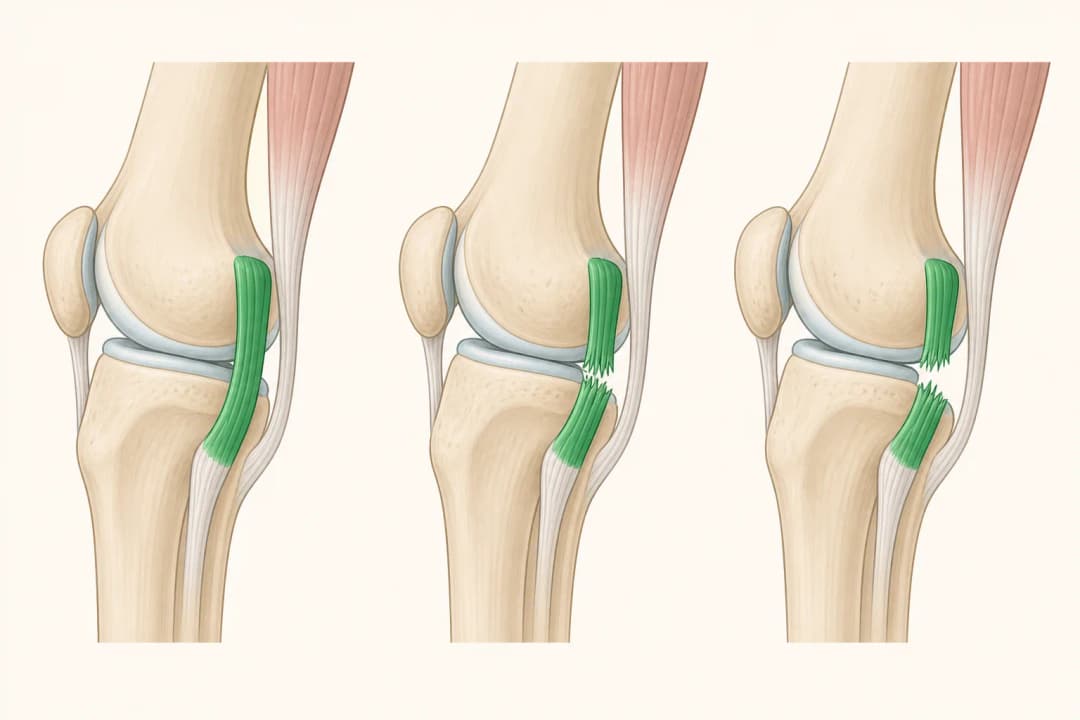
The medial collateral ligament supports the inside of the knee against forces that push it inward. Rehabilitation commonly develops knee motion, thigh and hip strength, single-leg control, balance and the ability to absorb force. Later stages can include jogging, acceleration, deceleration, lateral movement and controlled contact where appropriate. A brace may be advised for a period, depending on the injury and examination. Effectiveness means handling these demands without giving way, increasing swelling or loss of confidence.
How to progress
Use the loading plan provided by your clinician and avoid testing side-to-side contact before the knee is ready. Note swelling, tenderness along the inner knee and any sense of instability after exercise. Strength and movement checks can guide progression from straight-line work to cutting and sport drills. The [Return-to-Sport Programme](/treatments/physiotherapy-and-rehabilitation/return-to-sport-programme/) explains the staged approach.
When to seek care
Arrange a review if the knee repeatedly gives way, cannot fully bend or straighten, becomes increasingly swollen, or remains painful despite reducing activity. Seek prompt care after a new twisting injury if you cannot bear weight or the knee locks. An MCL injury can occur alongside other knee damage, so persistent instability deserves examination.
Questions for your doctor or physiotherapist
Is my injury stable enough for running? When can I add cutting or contact? Should I use a brace during training? Which strength or balance findings would make you delay my return?
Find care
General Clinics & Polyclinics in Abu Dhabi
That answer is general. If you want it applied to your own case, these are licensed general clinics & polyclinics listed in Abu Dhabi.
27 Ar Ruwwad St - Shakhbout City - MSH4 - Abu Dhabi - United Arab Emirates
Accepts: Daman, Thiqa, Cigna, MetLife +20 more
Al Ruwais, Al Dhafrah
Accepts: Daman, Thiqa, AXA, Cigna +16 more
Al Bahyah - Al Bahyah Old - Abu Dhabi - United Arab Emirates
Accepts: Daman, Thiqa, Cigna, Allianz Care +18 more
Abu Dhabi
Accepts: Daman, Thiqa, AXA, Cigna +27 more
Ordered by verification status and how complete each clinic's public record is, then alphabetically. This is a directory listing, not a ranking — Zavis does not rate or recommend providers.
A factual listing drawn from the DHA, DOH and MOHAP licence registers. It is not a referral, an endorsement, or advice that any of these providers is right for you.
Questions people ask
Does an MCL injury always need surgery?
Many MCL injuries are treated with rehabilitation, but the decision depends on severity, stability and associated knee injuries. A specialist examination is needed.
Can a brace make me ready to play?
A brace may support the knee in selected situations, but it does not replace restored strength, movement control and clinician-guided progression.
Keep reading
Medical disclaimer. This page is general health information, not medical advice, and it cannot diagnose you. Always consult a licensed healthcare provider about your own symptoms and treatment. In an emergency in the UAE, call 998 for an ambulance.