
What should you know about FUE FUT hair transplant?
Short answer
FUE takes individual follicular units from the donor area, while FUT removes a narrow strip to prepare grafts, and both require careful diagnosis and aftercare.
This answers one question. It is not a diagnosis and does not replace an assessment by a licensed doctor.
At a glance
- FUE
- Individual follicular units are harvested separately.
- FUT
- A donor strip is removed and divided into grafts.
- Shared need
- Both methods require diagnosis, design and aftercare.
How the techniques differ
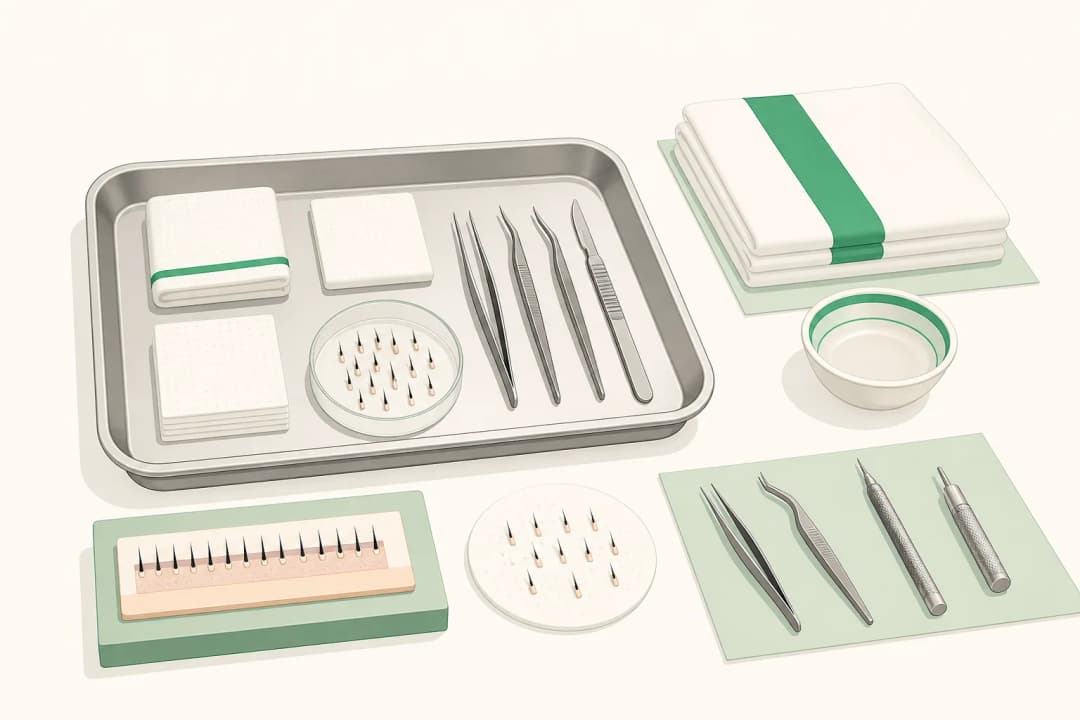
With FUE, follicular units are removed one at a time using a punch, leaving many small healing points. With FUT, a strip of hair-bearing skin is removed from the donor area and divided into follicular units; the donor wound is closed, leaving a linear scar. In either method, grafts are sorted and placed into recipient sites designed around the existing hairline and density.
The choice is not decided by a label alone. A clinician considers the direction of loss, donor hair characteristics, scalp laxity, previous procedures, hairstyle and whether future loss could expose treated areas.
Preparing for the procedure
Bring a complete medicine and supplement list and mention bleeding problems, allergies, scalp disease or earlier surgery. Clarify whether the clinic expects you to change any medicine; do not stop prescribed treatment without medical advice. Arrange practical support for the first day, follow washing instructions, and avoid rubbing or picking the donor and recipient areas. Your written plan should cover sleeping position, activity, pain relief and review appointments.
When to seek medical advice
Call the clinic if bleeding persists, pain becomes severe or progressively worse, or swelling spreads unexpectedly. Increasing warmth, redness, pus, fever or a foul smell may indicate a wound problem and needs prompt review. Seek urgent care for breathing difficulty or rapidly developing facial swelling. A sudden patchy loss, intense itching or marked inflammation after recovery should be assessed because it may reflect a separate scalp condition.
Questions to bring
Ask why FUE or FUT fits your donor area, where any scar would sit, how future hair loss affects the design, how grafts are protected, and which recovery findings are expected versus concerning.
Find care
General Clinics & Polyclinics in Abu Dhabi
That answer is general. If you want it applied to your own case, these are licensed general clinics & polyclinics listed in Abu Dhabi.
27 Ar Ruwwad St - Shakhbout City - MSH4 - Abu Dhabi - United Arab Emirates
Accepts: Daman, Thiqa, Cigna, MetLife +20 more
Al Ruwais, Al Dhafrah
Accepts: Daman, Thiqa, AXA, Cigna +16 more
Al Bahyah - Al Bahyah Old - Abu Dhabi - United Arab Emirates
Accepts: Daman, Thiqa, Cigna, Allianz Care +18 more
Abu Dhabi
Accepts: Daman, Thiqa, AXA, Cigna +27 more
Ordered by verification status and how complete each clinic's public record is, then alphabetically. This is a directory listing, not a ranking — Zavis does not rate or recommend providers.
A factual listing drawn from the DHA, DOH and MOHAP licence registers. It is not a referral, an endorsement, or advice that any of these providers is right for you.
Questions people ask
Does FUT leave a scar?
FUT closes the donor strip as a linear wound, so a linear scar can remain and should be discussed during planning.
Is FUE scar-free?
FUE leaves small healing points rather than a single linear wound, but it is still a surgical procedure that can leave visible changes.
Related
Related reading
Keep reading
Medical disclaimer. This page is general health information, not medical advice, and it cannot diagnose you. Always consult a licensed healthcare provider about your own symptoms and treatment. In an emergency in the UAE, call 998 for an ambulance.