
What Causes a Twisted Ovary?
Short answer
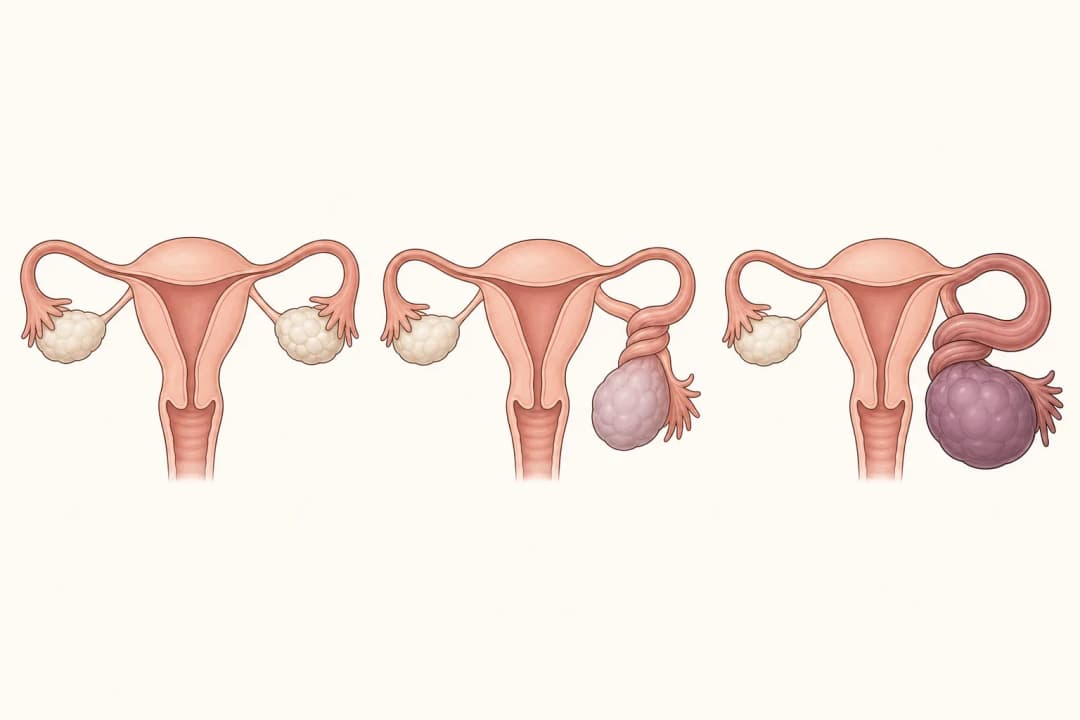
A twisted ovary, called ovarian torsion, happens when the ovary rotates around the tissues supporting it and may reduce its blood supply.
This answers one question. It is not a diagnosis and does not replace an assessment by a licensed doctor.
At a glance
- Medical term
- Ovarian torsion
- Typical concern
- Reduced blood flow to the ovary
- Priority
- Sudden severe pelvic pain needs emergency assessment
The short answer
An enlarged ovary or ovarian cyst can make twisting more likely, although torsion can also occur without an obvious trigger. Pregnancy, fertility treatment, or a naturally longer supporting ligament may alter how freely the ovary moves.
What ovarian torsion means
The ovary and fallopian tube are held in place by supporting tissues that contain blood vessels. When the ovary twists, blood flow can become restricted. The pain may be sudden and severe, or it may come and go if the ovary twists and untwists.
Common symptoms include one-sided pelvic pain, nausea, vomiting, and tenderness. A fever or feeling faint can develop when the problem has progressed. A clinician may use an examination and ultrasound, but symptoms and examination findings guide the decision about urgent treatment.
What to do next
Do not wait for the pain to settle if it is sudden, severe, or paired with vomiting. Contact emergency services or go to an emergency department so a gynaecology team can assess you promptly. Avoid driving yourself if you feel faint or are in severe pain.
Treatment usually aims to untwist the ovary and preserve it when possible. Surgery may also address a cyst or other cause of enlargement; a laparoscopic ovarian cystectomy is one procedure used to remove a cyst through small abdominal incisions.
When to seek urgent care
Seek emergency care now for sudden one-sided pelvic or lower abdominal pain, especially with nausea, vomiting, fever, marked tenderness, dizziness, or fainting. These features can signal a time-sensitive problem and should not be assessed only through self-care.
If pain is milder but keeps returning, arrange prompt medical review. Mention any known ovarian cyst, pregnancy, fertility medication, or recent pelvic procedure.
Questions for your doctor
Ask what findings support torsion, whether an ultrasound is needed, and how quickly treatment should happen. You can also ask whether an ovarian cyst or another pelvic condition could be contributing to the symptoms.
Find care
General Clinics & Polyclinics in Abu Dhabi
That answer is general. If you want it applied to your own case, these are licensed general clinics & polyclinics listed in Abu Dhabi.
27 Ar Ruwwad St - Shakhbout City - MSH4 - Abu Dhabi - United Arab Emirates
Accepts: Daman, Thiqa, Cigna, MetLife +20 more
Al Ruwais, Al Dhafrah
Accepts: Daman, Thiqa, AXA, Cigna +16 more
Al Bahyah - Al Bahyah Old - Abu Dhabi - United Arab Emirates
Accepts: Daman, Thiqa, Cigna, Allianz Care +18 more
Abu Dhabi
Accepts: Daman, Thiqa, AXA, Cigna +27 more
Ordered by verification status and how complete each clinic's public record is, then alphabetically. This is a directory listing, not a ranking — Zavis does not rate or recommend providers.
A factual listing drawn from the DHA, DOH and MOHAP licence registers. It is not a referral, an endorsement, or advice that any of these providers is right for you.
Questions people ask
Can an ovarian cyst cause a twisted ovary?
Yes. A cyst can enlarge or add weight to the ovary, making rotation around its supporting tissues more likely.
Can ovarian torsion come and go?
It can. Partial twisting may cause intermittent pain, but recurring episodes still need prompt medical assessment because the ovary may twist further.
Related
Related reading
Keep reading
Medical disclaimer. This page is general health information, not medical advice, and it cannot diagnose you. Always consult a licensed healthcare provider about your own symptoms and treatment. In an emergency in the UAE, call 998 for an ambulance.